Well….isn’t that a good question. To tell you that story, I need to tell you this one first. Fasten your seatbelts, you are in for a very, very bumpy ride. In summer 2024, my husband and I bought a new house. Hubs’ plan was grad …
Ok. If you never take heed of any of my tips but this one, that would be okay. (Not really, I give awesome tips, so you should definitely listen to them all….but this one is really, really helpful) When starting a Pattern, any pattern, honestly, …
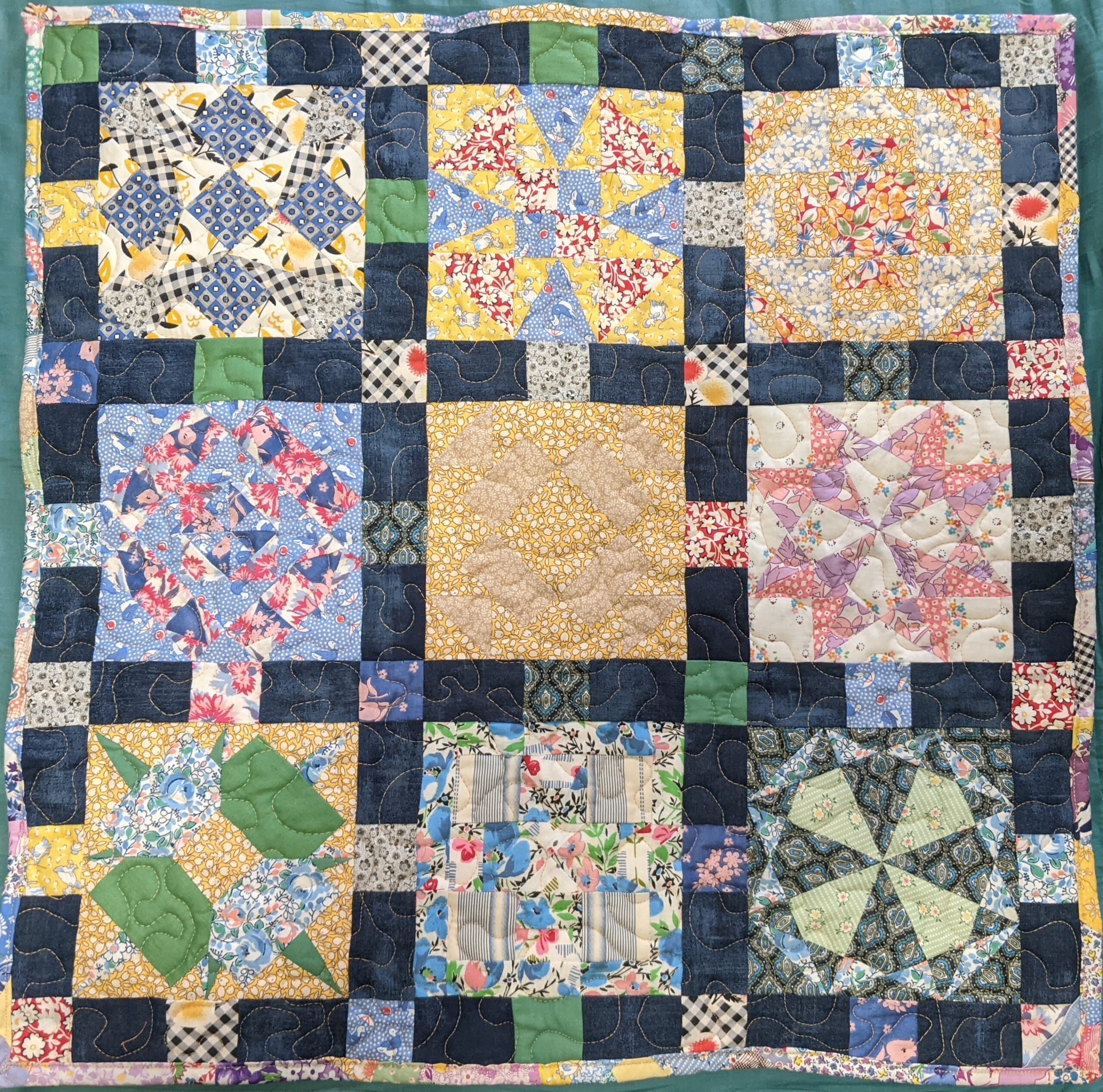
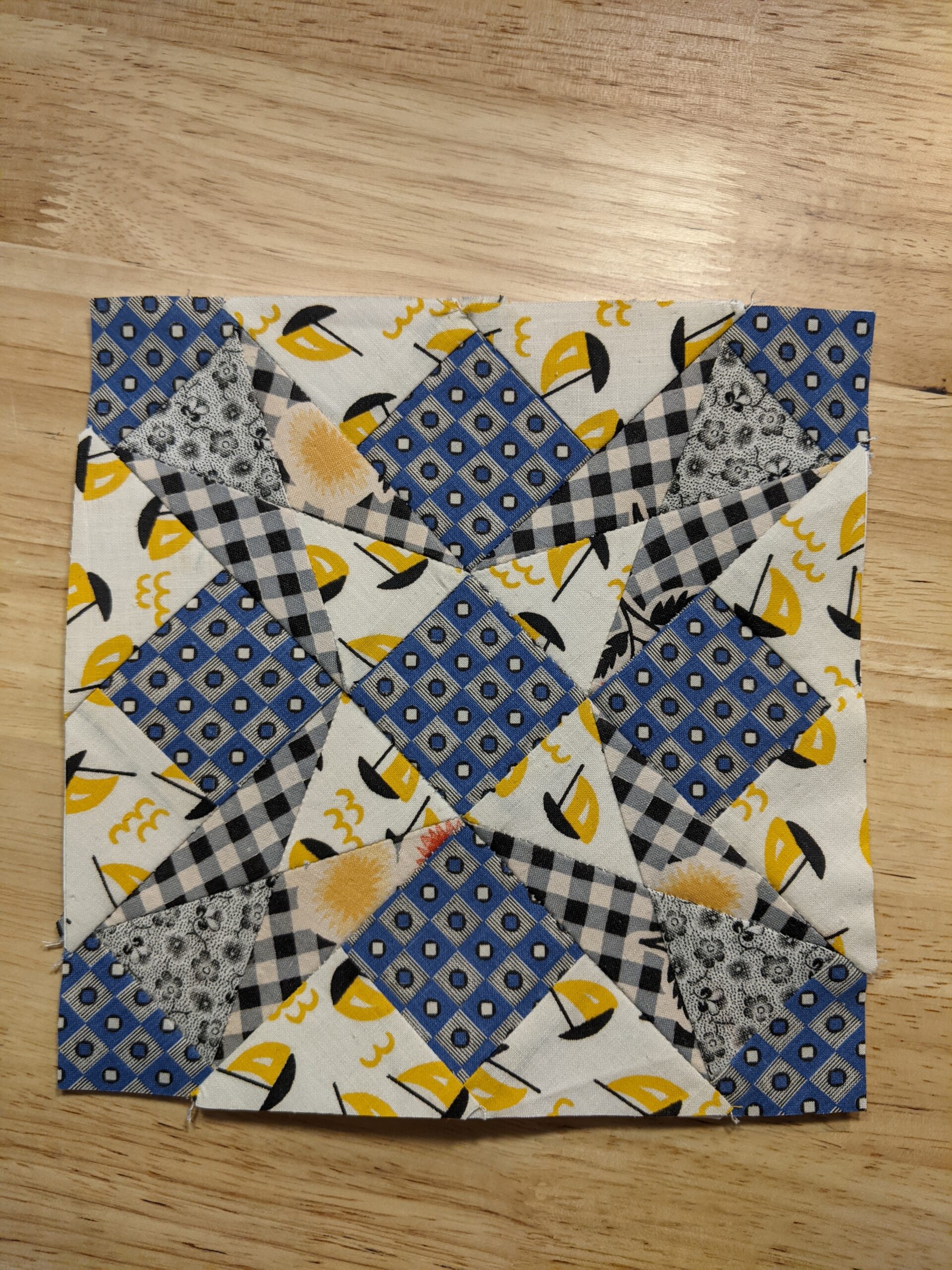
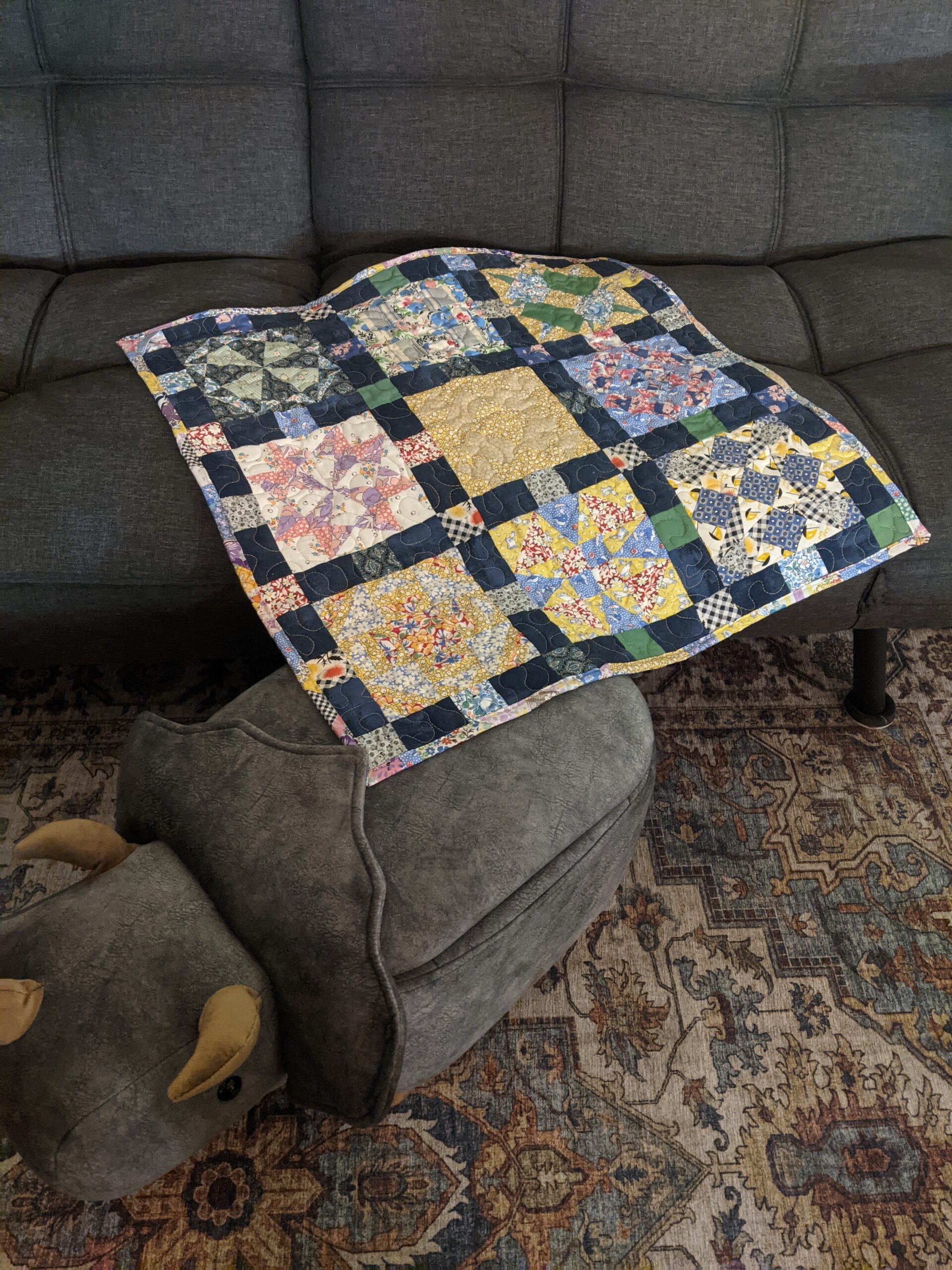
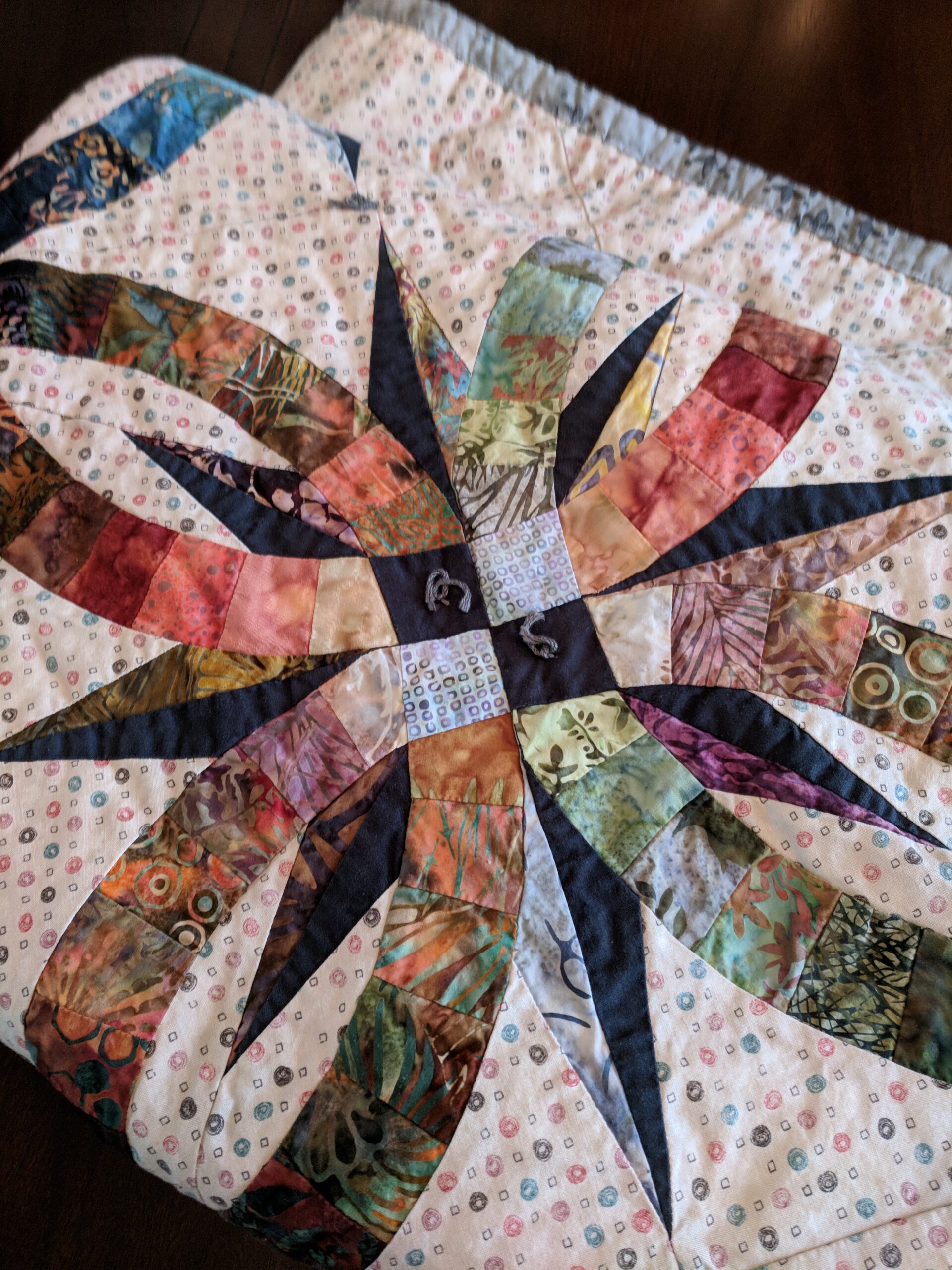
Nope. Nope. Nope!! A Miniature Quilt, in fact, means much more work in a teenier space! Here’s a quick glimpse of a Miniature Quilt I worked on for a Competition Show this May. The Competition was to create a Miniature Quilt that had no pieces larger than a 3 inch square…or basically any piece larger than nine square inches.
According to the Competition Rules, you were allowed to use a larger piece for the binding and back. I didn’t. I know….I’m such a rebel. Actually, I’m just a glutton for punishment.
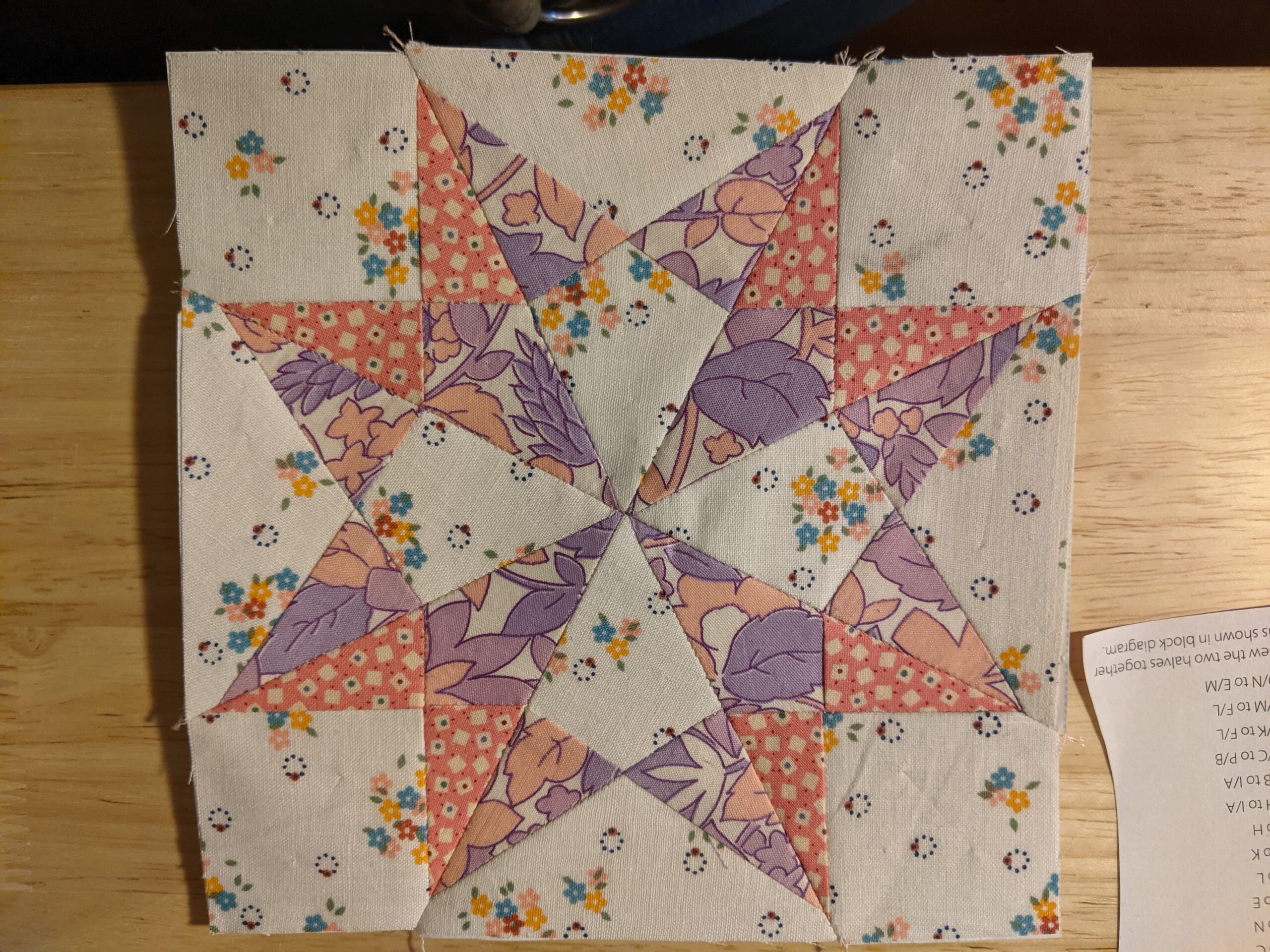
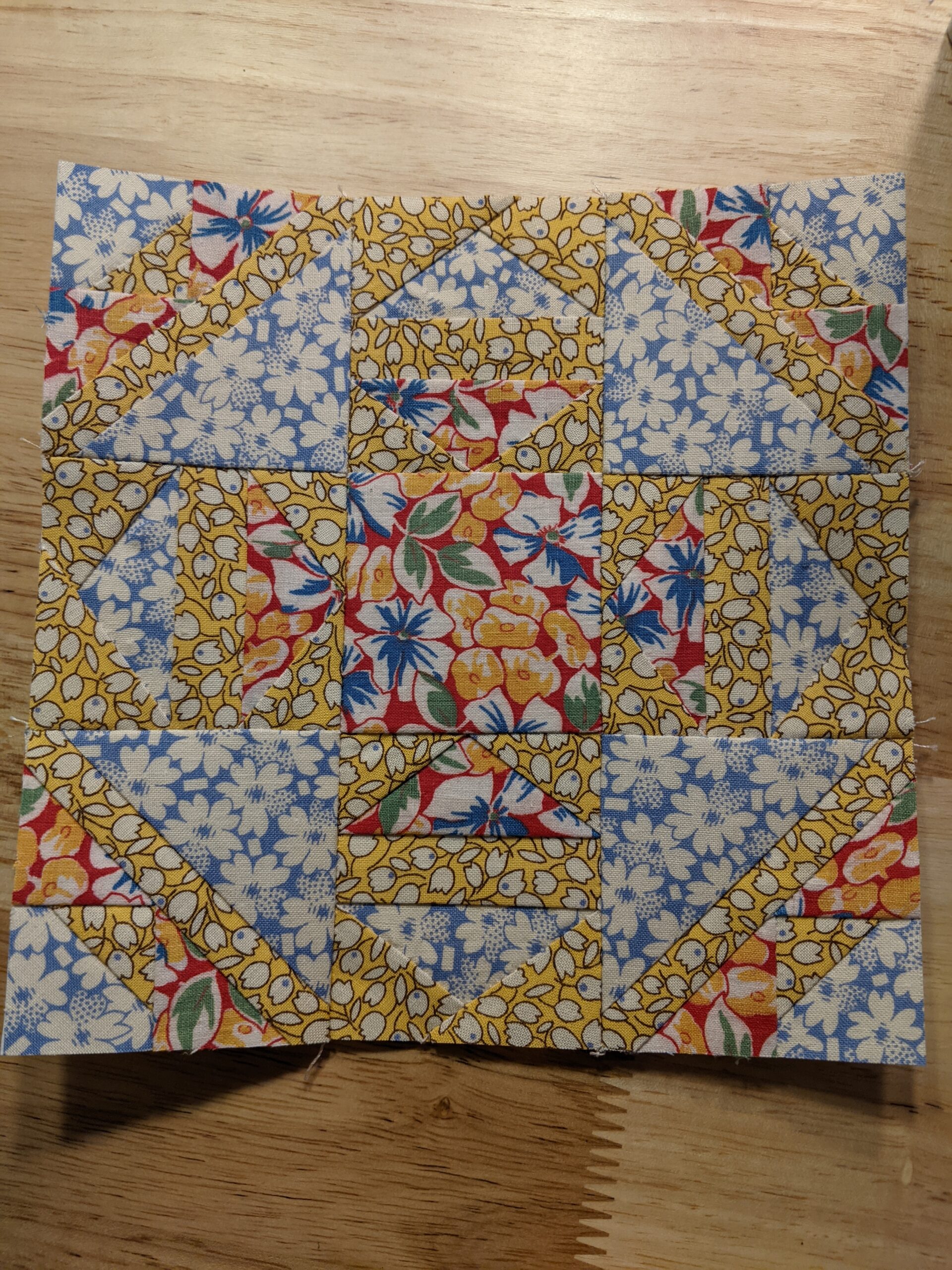
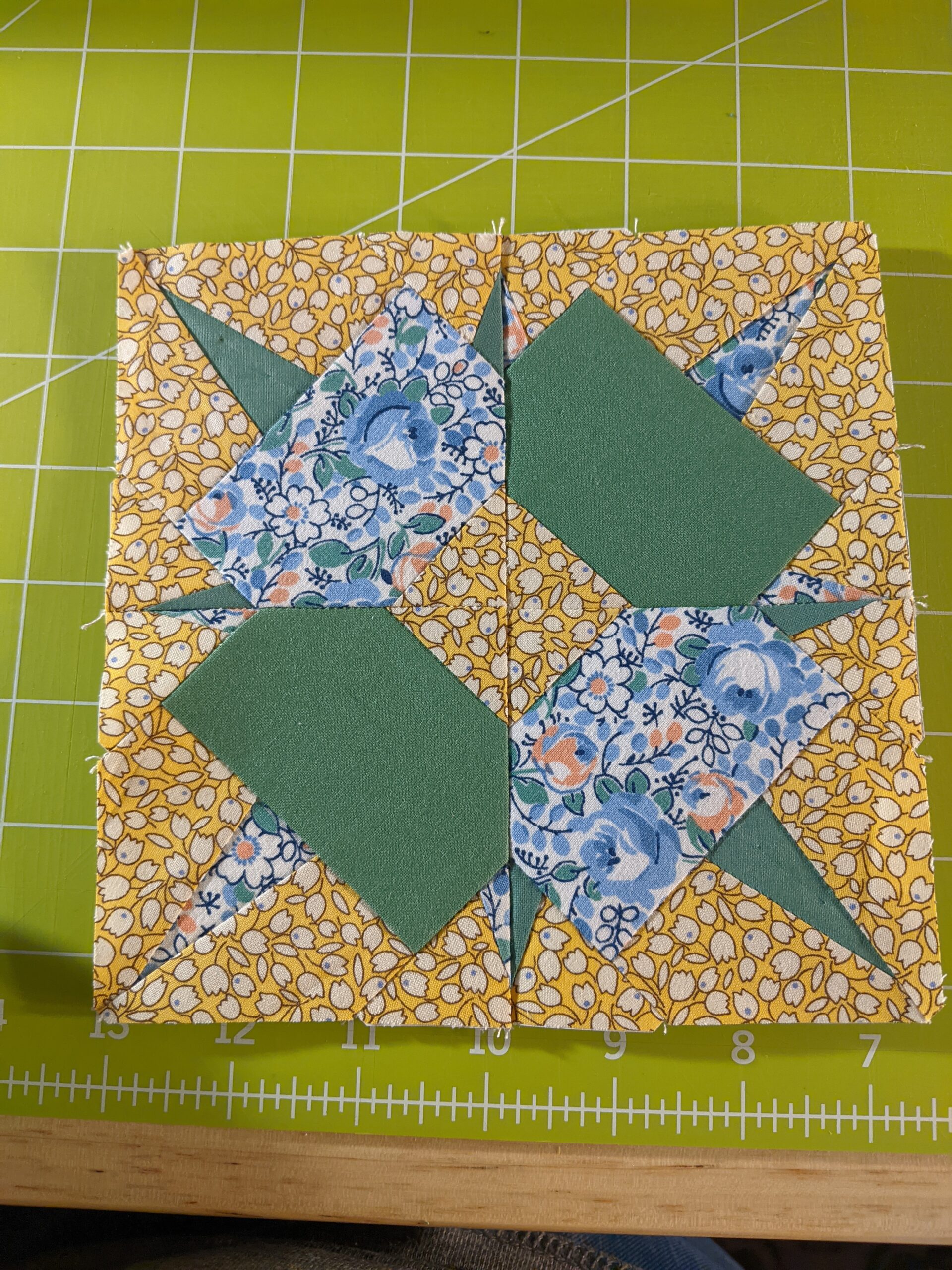
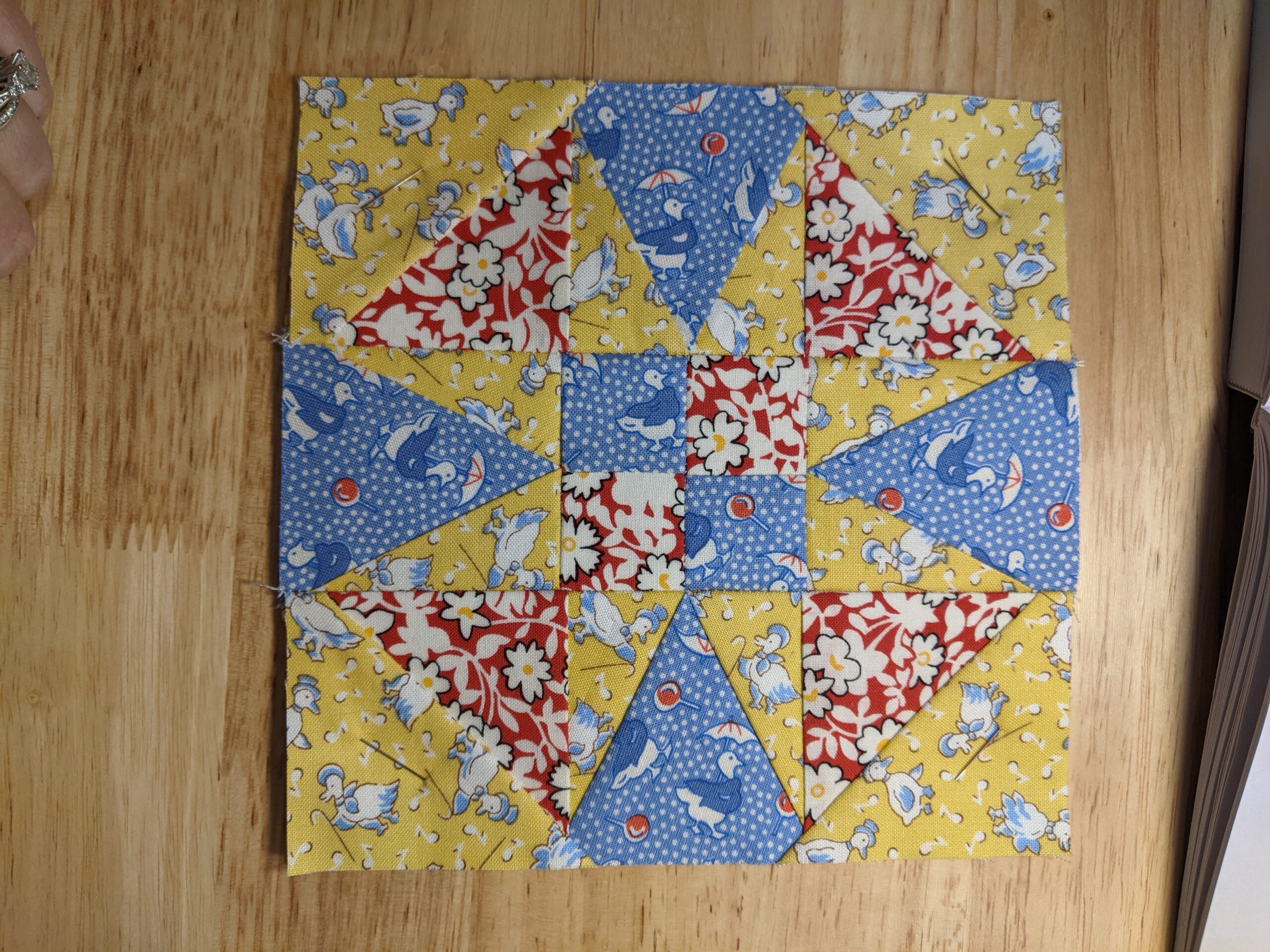
As you know, I’ve been trying to de-stash, so, I had this great grab-bag of vintage 1930’s scraps I had picked up from a Quilt Show over a decade ago and as Luck would have it, (that sentence is even funnier if you know my husband’s nickname is Lucky) my husband got me a copy of The Farmer’s Wife, which is a sampler of 1930’s blocks that are paired with real letters from the wives of Farmer’s during the Depression. It was meant to be: a new Sampler book of tiny blocks meets a bag of vintage scraps I need to de-stash…Voila! A Miniature Quilt design!
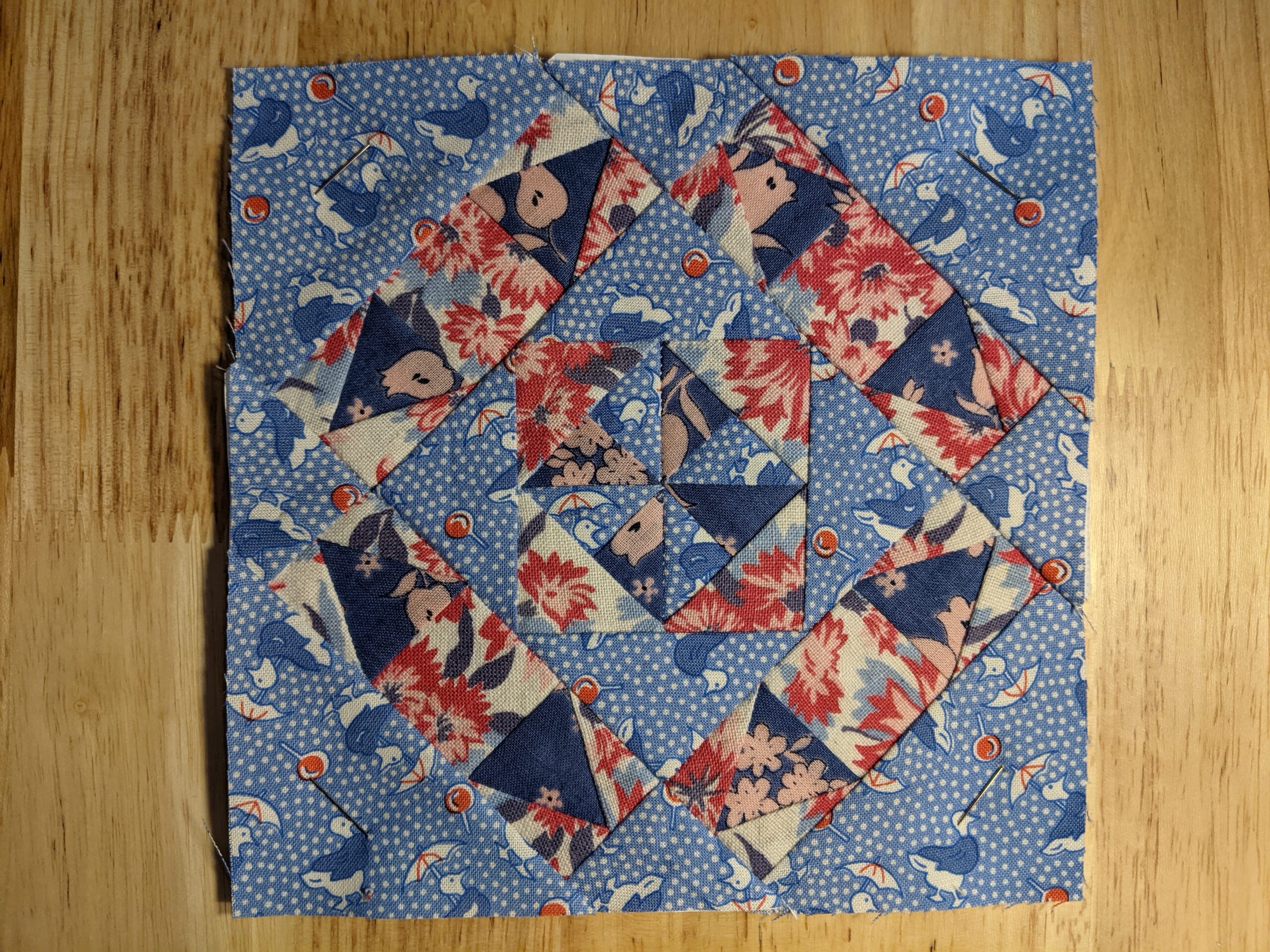
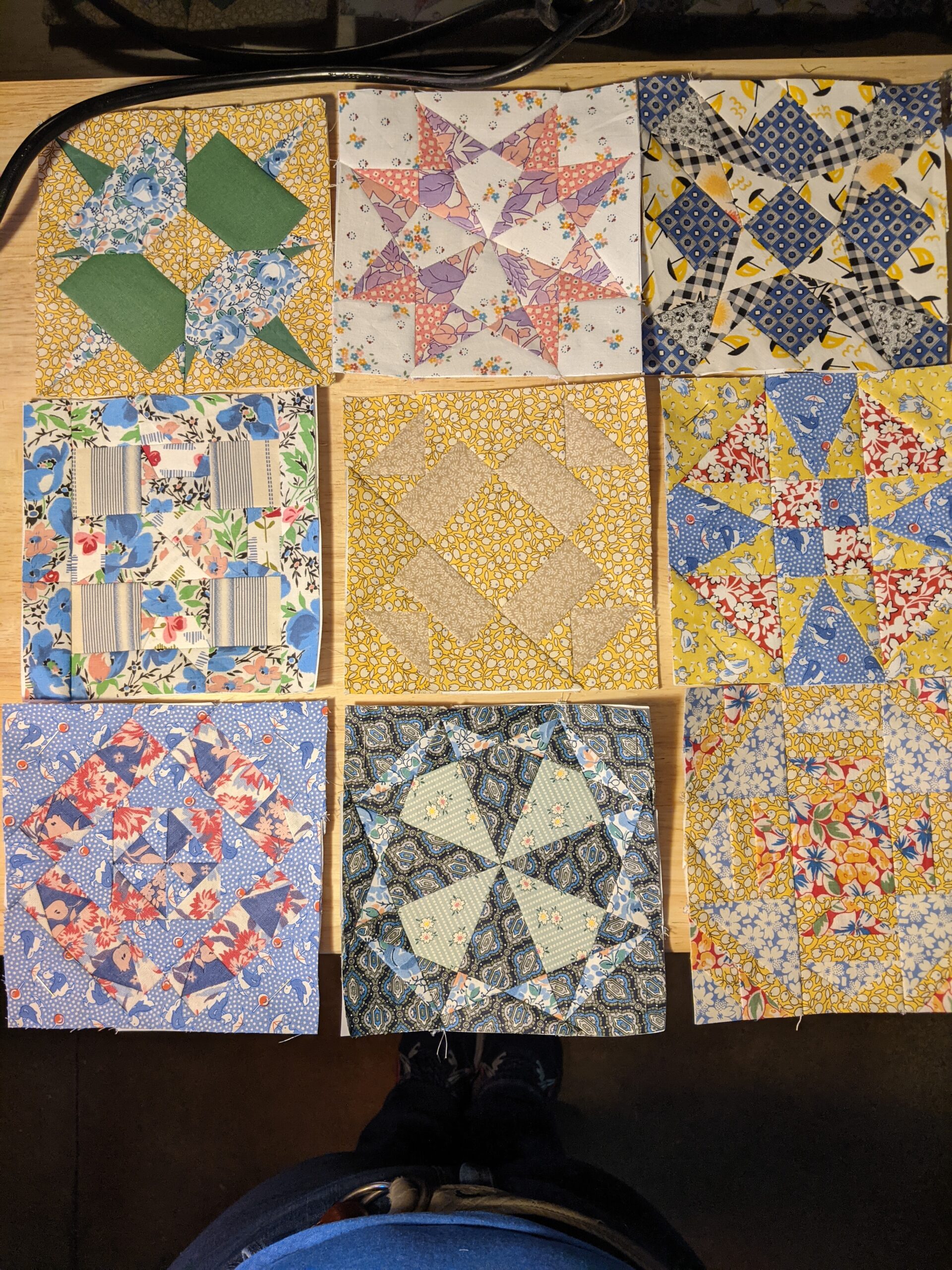
Each of these blocks are named from these wives’ letters, so here’s some close-ups for you to peruse. This is six of the nine blocks:
I actually Foundation Paper Pieced the blocks. The Farmer’s Wife book has a link to electronic files where you can get Foundation Paper Piecing papers as well as templates for hand quilting, etc. I thought this would be the most efficient way to get accurate piecing.
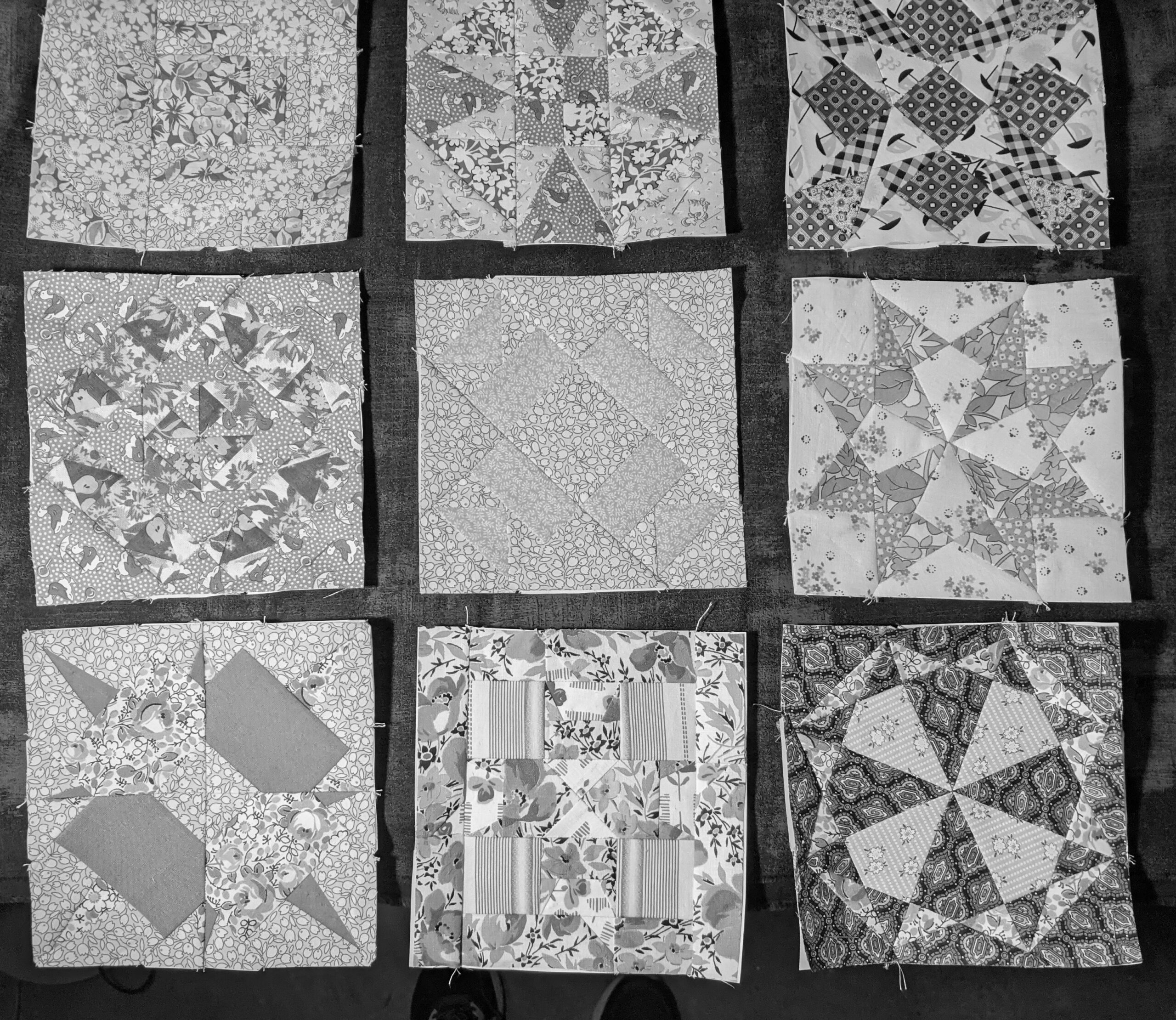
I definitely had some contrast issues with this quilt. You can see it in the pictures. I was trying to go for some monochromatic blocks and ended up losing a lot of the design. I probably should have redone those blocks with other colors, but time was very much not on my side and I needed to trudge through.
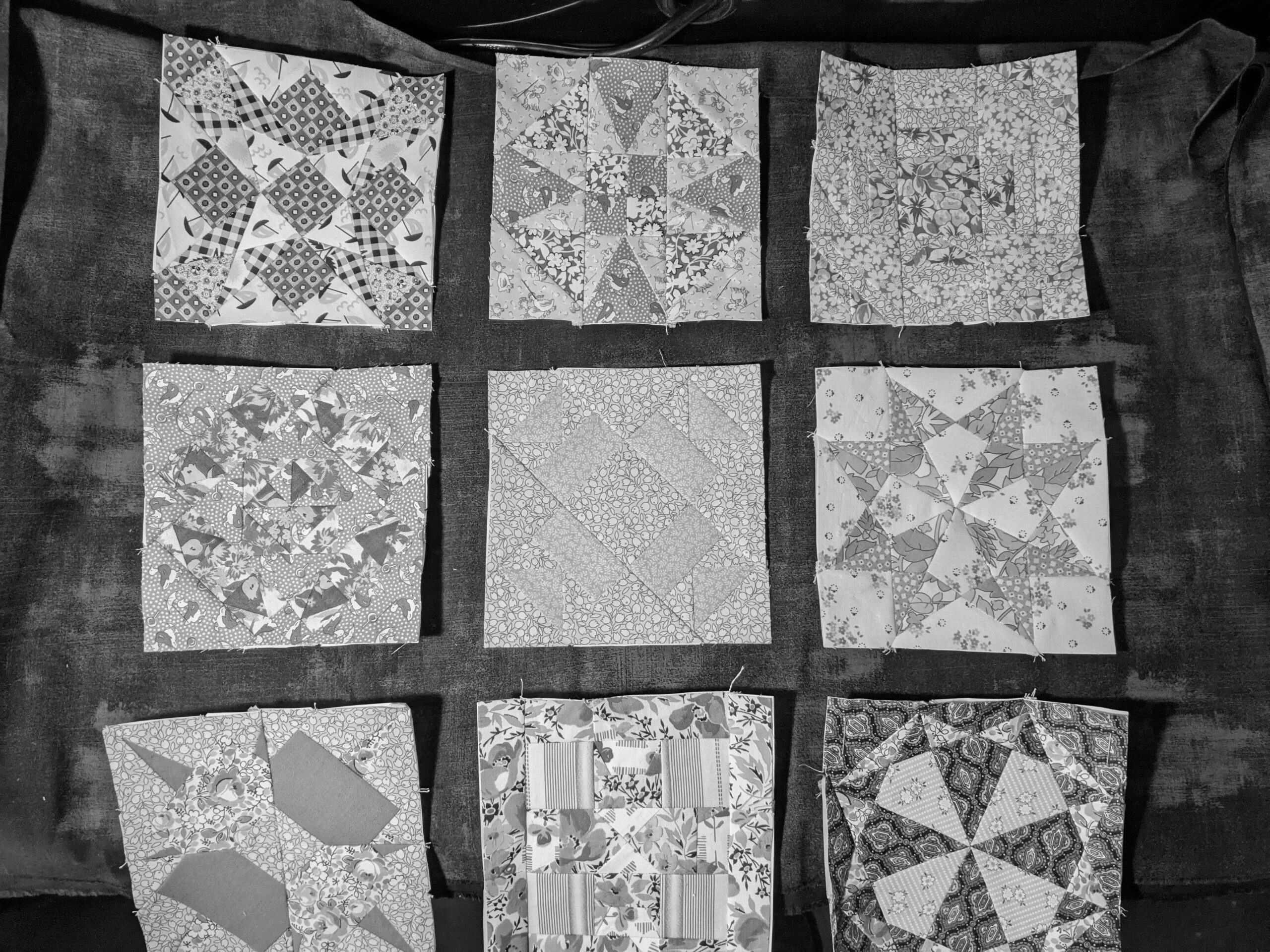
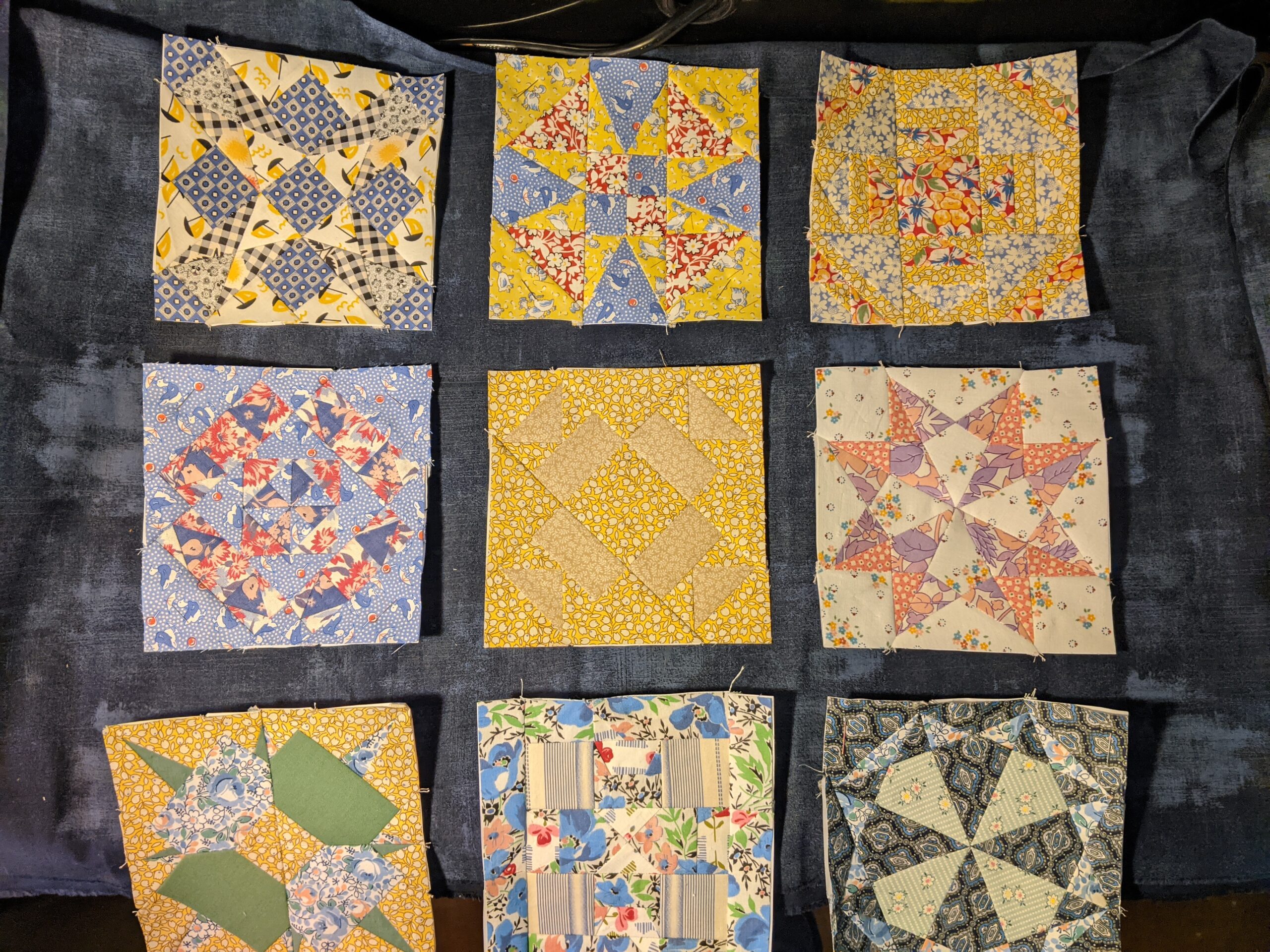
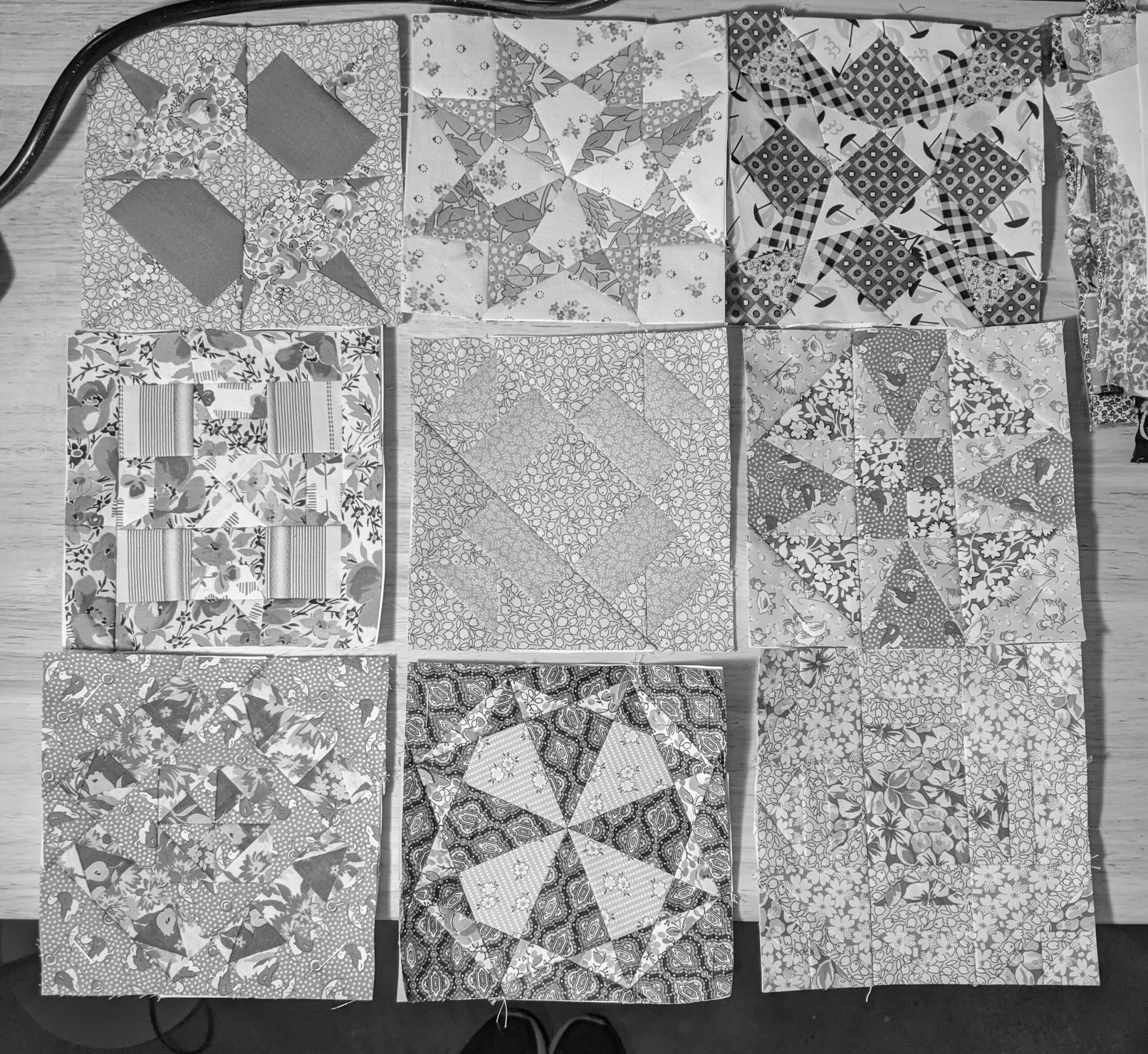
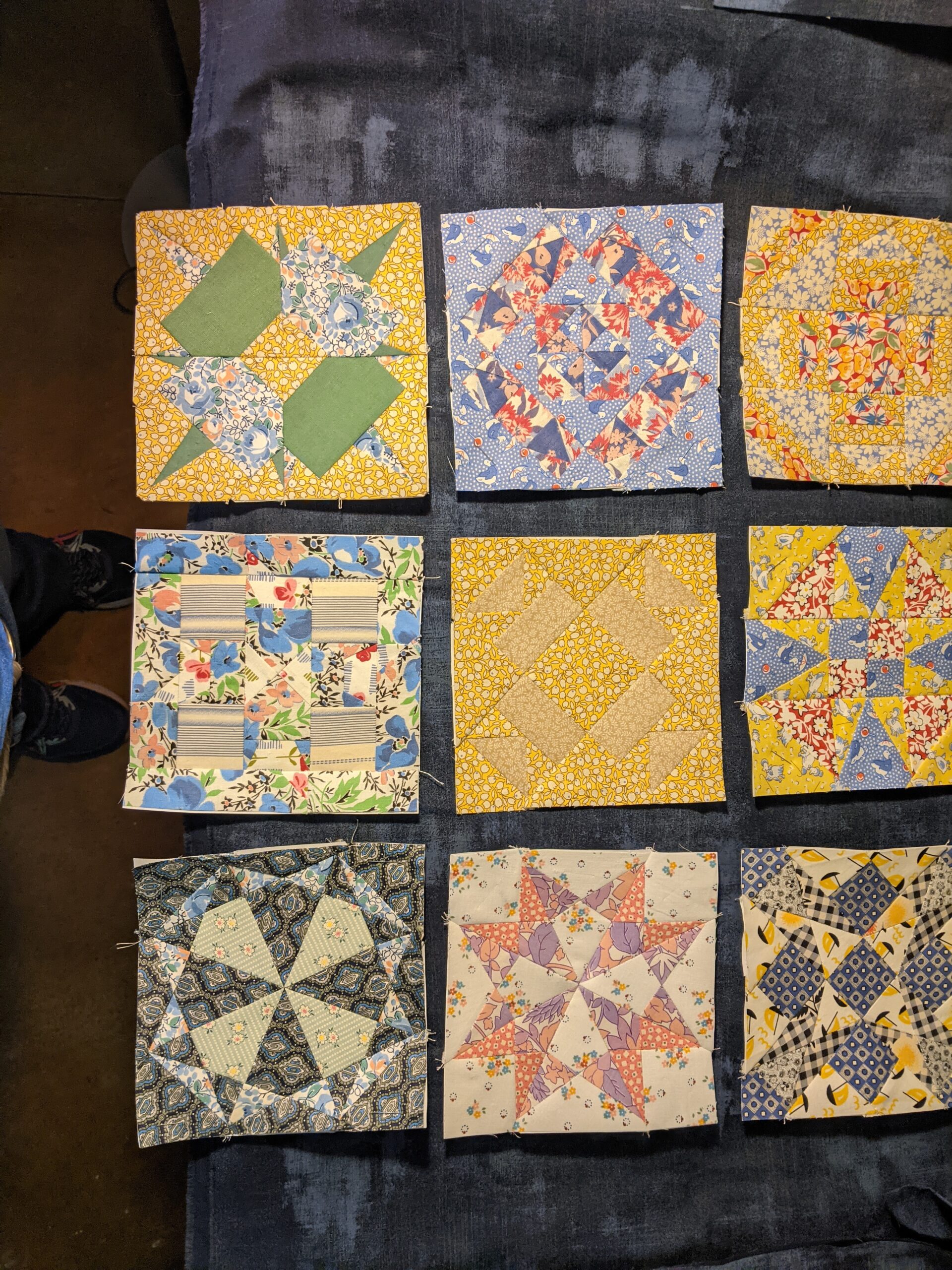
I used a fun trick to help me with this. If you ever need to check the volume of your quilt, snap a picture of it with your phone and then pull the saturation to zero. It turns your photo into black and white so that you can look at just the volume of the fabrics without the colors distracting you. This is the quickest and easiest way to check your volume. I use this trick all the time. Check it out below, as I was auditioning layouts and sashing fabric:
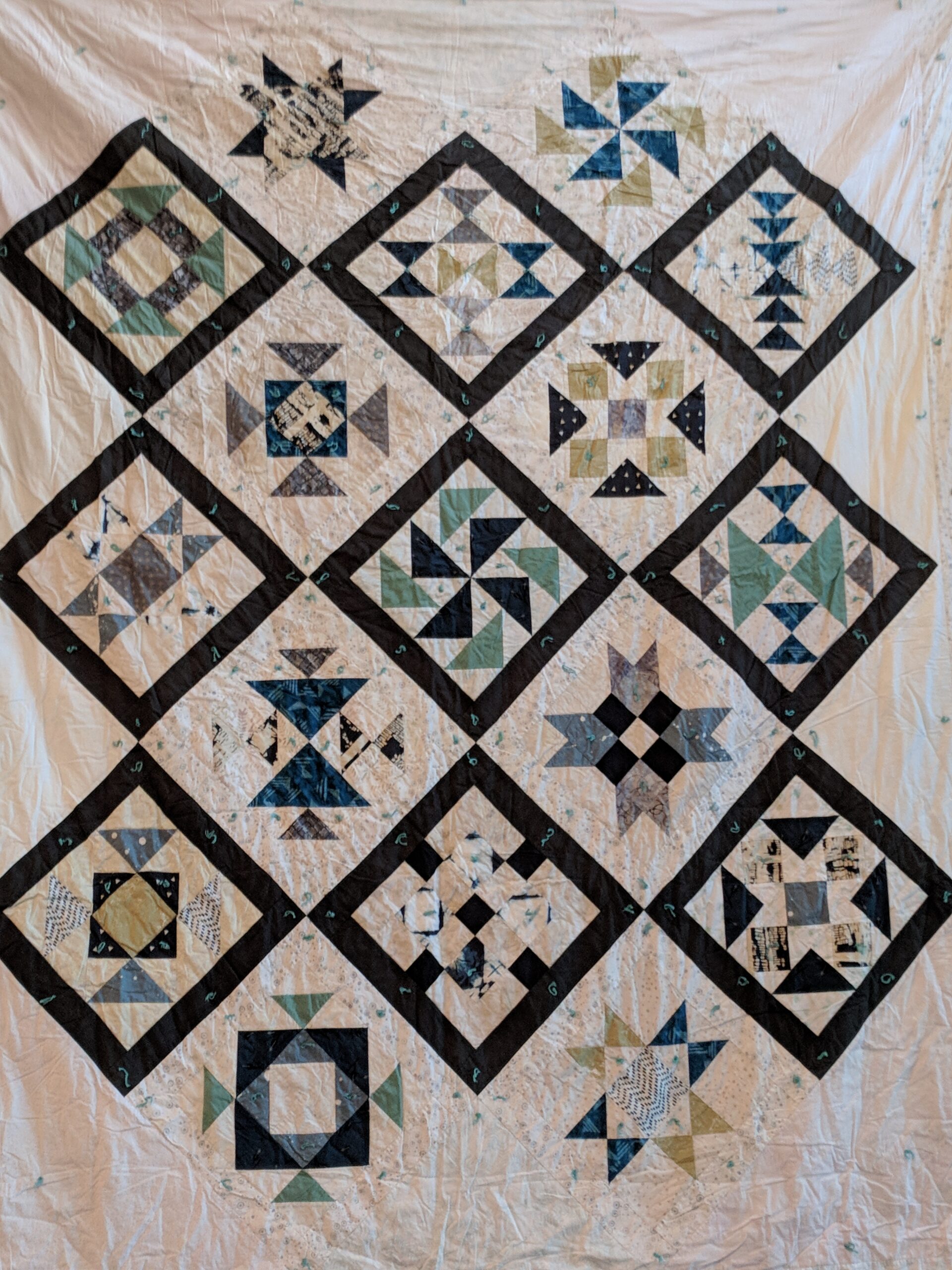
I decided to use a very dark inky grunge fabric for the sashing to help with the contrast issues and then I fussy-pieced the “cornerstones” to ensure that the sashing lined up as perfectly as I could get it to.
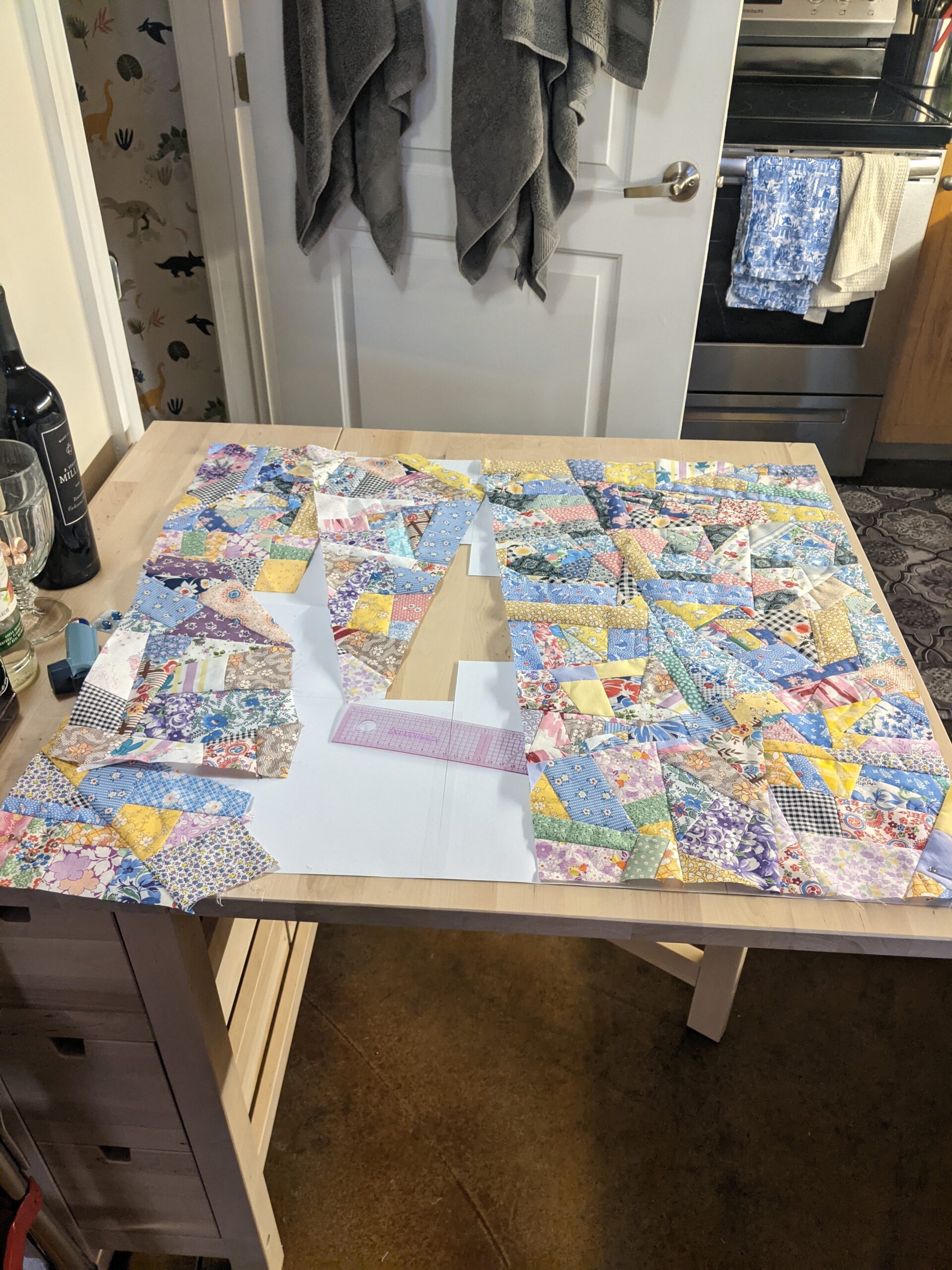
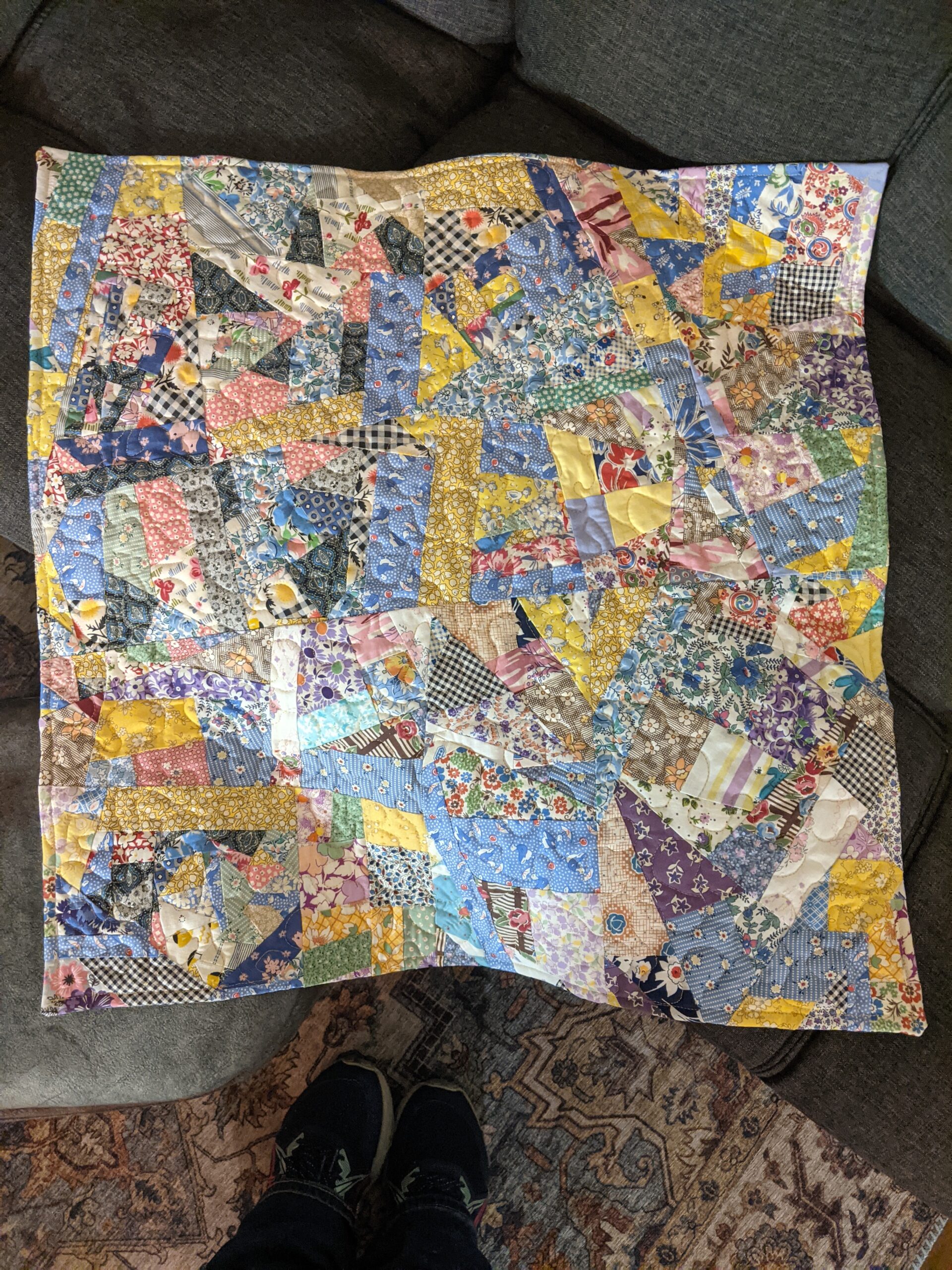
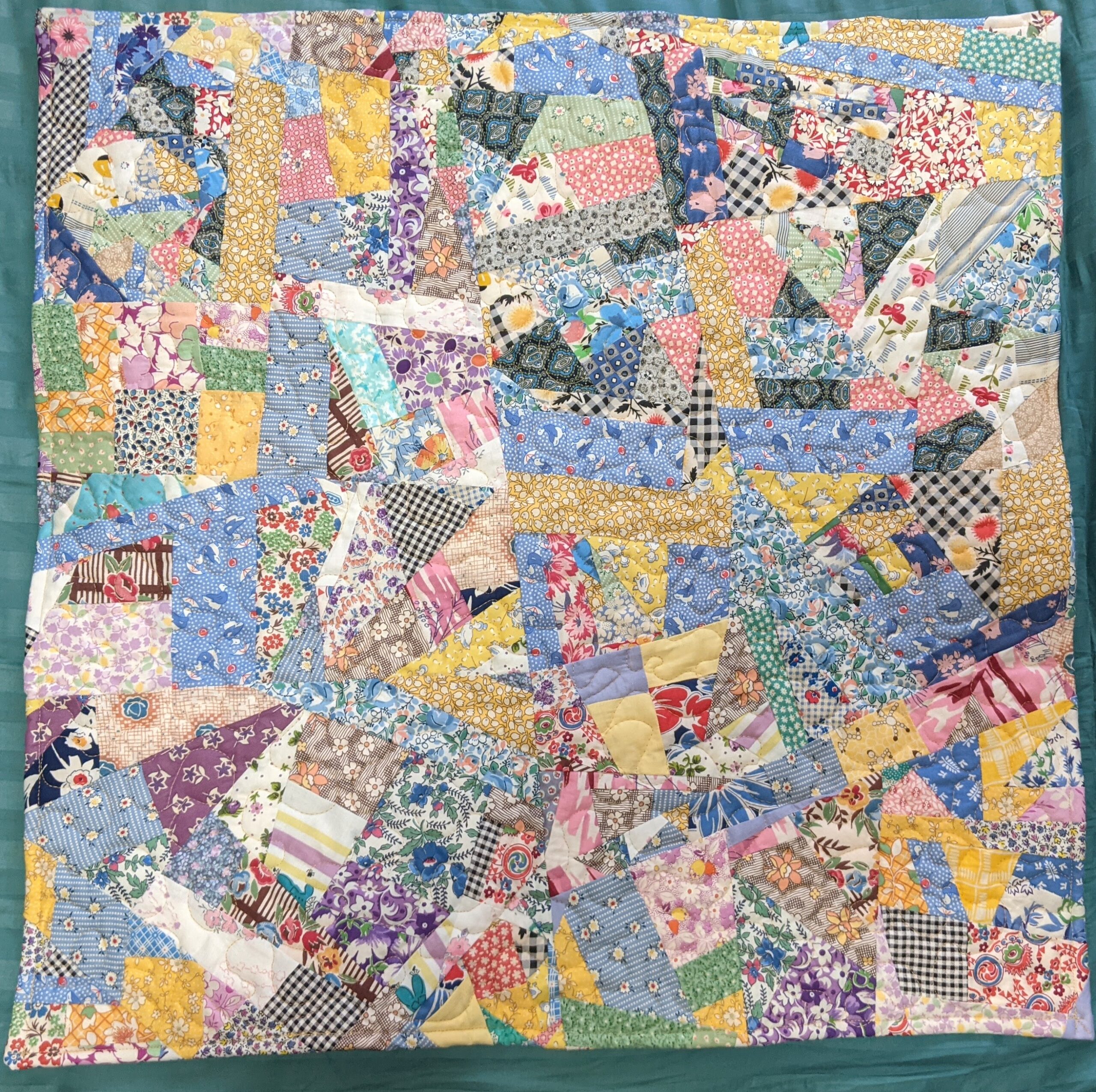
For the back, like I said before, I am a glutton for punishment, so I decided to piece the entire back with scraps ensuring that not a single piece of fabric was larger than 9 square inches. I put it together as a Crazy Quilt….so the back is probably just as intricate as the front (if not more so).
To do this, I started a pile of scraps and then sorted the scraps by edge sizes. Basically, if one edge of a scrap of fabric was about two inches wide, they all went in one pile. This way, as I continued on to the next step, I already had pieced that I could stack right sides together and just run through my machine.
From the piles, I used all of these scraps as my Leaders and Enders as I was working on the front. Instead of stitching on a scrap piece of fabric in between chain piecing to prevent bird’s nests/thread puke, I just grabbed two scraps out of the same pile with similar edge sizes, smushed them right sides together and ran them through the machine, then went back to my regularly scheduled piecing. When I snipped all my chain piecing apart, I would put the scraps in a different pile. When I needed to press something for the front, I would also grab the now-pieced scrap pile and press those, too.
Then those scraps would get put back into piles with their new similar edge sizes and the whole process would repeat. With this Leader and Ender method, by the end of piecing the front, I had pieced together most of the back, too.
I also made a paper template (see picture below) that was the size I needed the back to be to ensure that I had enough “fabric” to back my quilt top and be able to wrap it around to the front to be the binding as well. Every once in a while, I would just slice a large crazy quilted piece in half, and then attach it to somewhere else to keep the scraps as blended as possible. I LOVE how the back came out.
Paper Template to ensure the proper size of the Quilt BackFinished Crazy Quilt back
This Quilt did not win any prizes in the competition, but did receive a pretty decent technical score, so I was happy with that. Better luck next year!
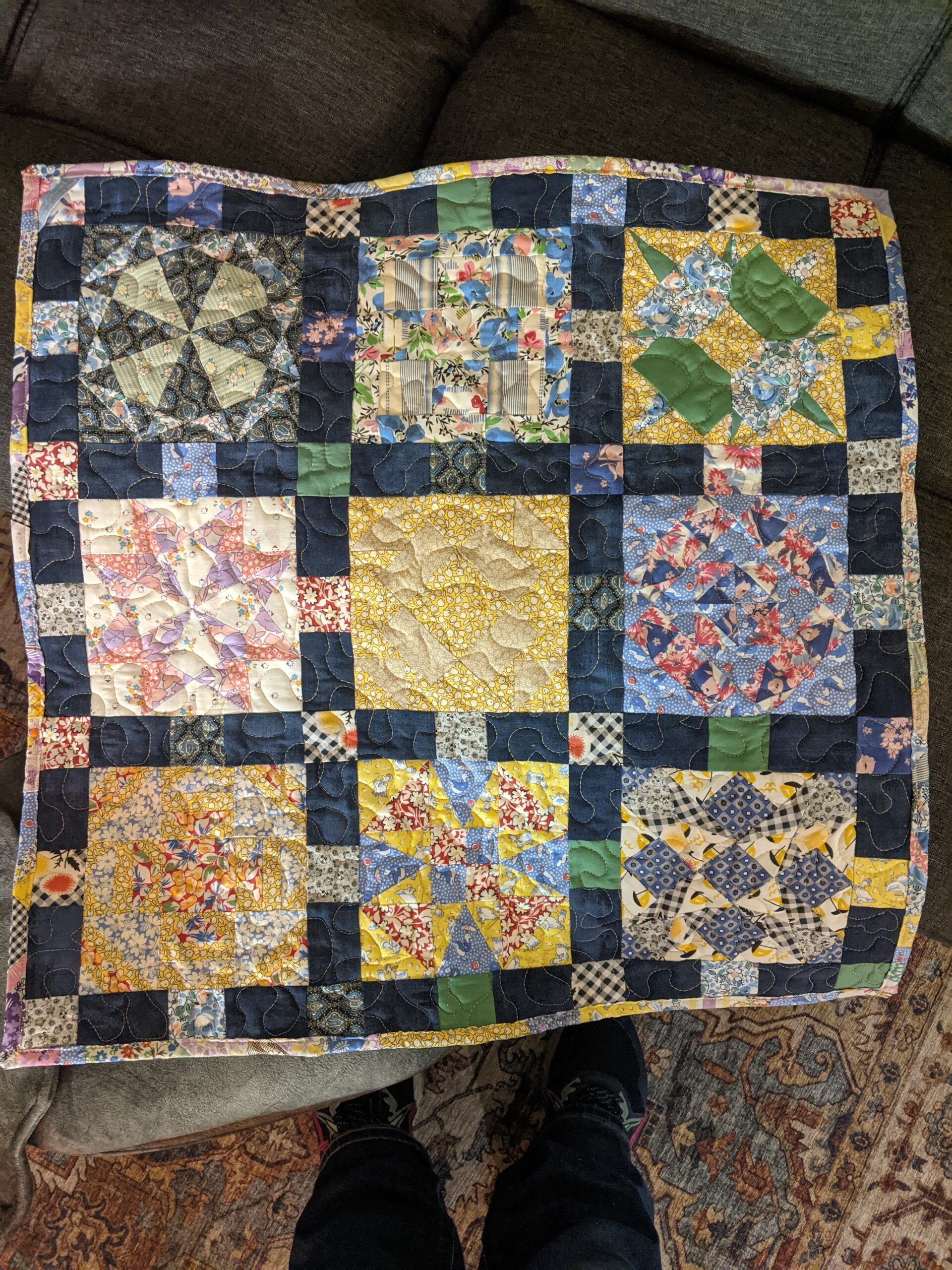
Finished Miniature Quilt FrontFinished Miniature Quilt Back
Here’s the details on this un-named Miniature Quilt
Title: Miniature Quilt Pattern: The Blocks are from “The Farmer’s Wife 1930s Sampler Quilt: Inspiring Letters from Farm Women of the Great Depression and 99 Quilt Blocks That Honor Them,” Book by Laurie Aaron Hird. The sashing and back are original designs. Size: Miniature, finished ~24″ x 24″ Fabric: A 1930’s grab bag of Scraps, some repro 1930’s fabrics and some navy Grunge, all from the stash! Piecing: Machine stitched mostly on Mavis, the Bernina 770 Cutting: rotary cut Quilting: Stipple Quilted by me on Mavis using her BSR. Backing: Completely pieced as a Crazy Quilt Label: none but my Bookerworx tag (I know, shame on me) Batting: Warm and Natural, by The Warm Company Finished Date: May 2023 Total Hours: Did not track (I’m terrible, I know)
Here’s another older finish that I thought I’d show you all. Trying to show some of my COVID makes to catch up a bit. Remember when I showed you the Wedding Quilt Modern Bliss in Blue? And remember how I told you about how this …
It is so very refreshing to be able to work on Wedding and Baby Quilts!! I love happy occasions! A Quilt for Benjamin was made for my cousin Mary’s baby. He got it a little late (admittedly, after his first birthday…..) but there were a …
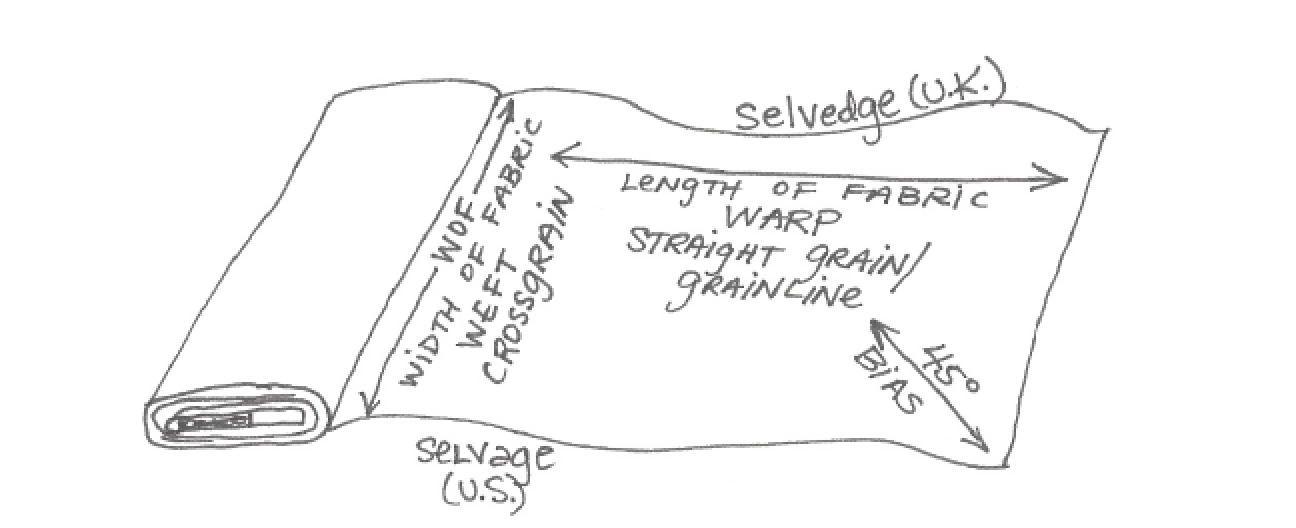
Often, while reading patterns, using die cutters, laying out patterns before cutting, and doing other general sewing and quilting things, fabric anatomy gets brought up. Don’t get too caught up by the lingo, as it seems a bit more complicated than it needs to be. Here’s some helpful definitions and also some diagrams (drawn by yours truly) that may help.
Length of Fabric – Typically, in sewing and quilting, fabric is manufactured and placed onto rolls or bolts. From there it gets cut down into smaller pieces either by someone at the store to cut you yardage, to make pre-cuts or by you, if you purchase the whole bolt. If a pattern says to cut this by “length of fabric,” they mean this direction….as if it was straight off of the bolt. The selvage runs along the edge of the fabric parallel to the length of fabric. It can be as long as you like, as long as there’s enough fabric on the bolt. Fun Fact: Generally, fabric tends to come on a bolt with a length of 40 yards or 100 yards. Also, for all you history buffs, a “bolt” is a sailing term, and specifically refers to canvas for sails. In that usage, a “bolt” is a unit of measurement….39 yards of sailing canvas, to be precise. Who knew?
Width of Fabric – also referred to as W.O.F. or WOF. The width of fabric varies greatly from manufacturer to manufacturer and also varies with fabric type. Generally (and I use this term loosely!), quilting cotton comes in 42″-44″ and 108″ widths and garment fabric comes in 60″ widths.
Selvage/Selvedge – Selvage (the American spelling) and Selvedge (the U.K. spelling) refer to the edges of the fabric that sometimes look a little funny. Typically in quilting cottons, the one side of the selvage is white and usually has pertinent information printed on it, like Manufacturer and Designers name, the name of the fabric collection, the colors used in printed the fabric, etc. The opposite side of the selvage has tiny little holes in it and is sometimes a bit stiff. The selvage is used to stretch the fabric onto the “loom” during the manufacturing process (hence the tiny little holes). Why do we need it? Well it’s helpful to have the Fabric info sometimes and, more importantly, it helps identify the length and width of the fabric, and the grain at the same time. Remember: The length of Fabric always runs parallel to the selvage.
Grain of Fabric – The grain refers to the direction of the little strings that are woven together to make the fabric. This is very important as all three directions (see below) have their own characteristics. Always follow the directions when cutting, laying out or sewing, as using the incorrect grain can really ruin your end result. Look below for more information about these. Please also see Length of Fabric and Width of Fabric for more information.
Lengthwise Grain/Straight of Grain/Grain Line/Warp – The Lengthwise Grain are the fibers that create the foundation of the fabric. These are always PARALLEL to the selvage. (Remember back to school: Parallel is the two train tracks that never touch, but run next to each other…..) The Straight of Grain has the LEAST amount of stretch of all the directions of fabric. Generally, garments are cut with the straight grain running top to bottom, but always follow your pattern’s direction. Think of this: If you made a garment that didn’t have the straight grain running top to bottom and you put a hem on it, the weight of the hem could stretch the garment and cause it to droop. Sometimes you want the droop, but for a structured garment, you would not. Often when cutting fabric with a die cutter, you want to pay attention to this grain line as well to avoid distortion of your pieces.
Crosswise Grain/Crossgrain/Weft – The Crosswise Grain are the fibers that fill-in the foundational lengthwise grain fibers. These are always PERPENDICULAR to the selvage. (Remember back to school: Perpendicular lines form a right (90 degree) angle, just like a wall would to the floor…..or like a capital “T”) The Crossgrain has stretch to it. Often, garments are cut with the crossgrain parallel to the floor to create stretch around the wearer. Think of this: If you had a pant leg, you would not want the crossgrain to run up and down the leg, as this would cause the hem to stretch constantly, and your pants would be too long. However, if you had the crossgrain run around your leg, it would offer you some stretch when you went up stairs, or sat down or walked, etc.
Bias/Bias Grain/True Bias – The Bias Grain is any thing cut between the warp and the weft. The “True Bias” is a diagonal cut at 45 degrees. Fabric on the bias is the most elastic and fluid than in any other direction. This is used for things like piping, neckties and bias-cut skirts. Bias-cut garments drape the most and fit with the most stretch. Think of the flowy, pencil style gowns of the 1920’s…..these have that gorgeous drape because of the bias cut…note that you won’t see a heavily beaded hem or anything like that….it would distort the garment. In quilting, one needs to be wary of bias cuts when sewing triangles. If you aren’t careful, you will distort your block and you will not get a straight seam. Bias tape is often used in binding. It helps because the binding will stretch as you work with it and be flexible when you fold or roll the quilt. You definitely want this if you are binding scalloped edges.
How to find the Grainline:
Ok, here’s quandary Number 1: I found a large scrap of fabric, but it has no selvedges on it. How do I find the grain??
Answer: Well…..start by looking at it. You should see fibers crossing over each other. At this point, you can determine that there’s grains…..but which one is which? Next, try holding the fabric and stretching it along those fibers. It will stretch more in one direction than the other. The direction with the least amount of stretch is the Straight of Grain.
Quandary Number 2: I have to cut a very long length (let’s say you need to cut sashing or a border for a quilt) but I need it to be along the grain line so that my finished quilt top isn’t distorted. (Yes!! This is why your quilt isn’t laying flat at the end of the day!) How do I ensure that I cut this border whilst keeping it along the grainline for the whole of the cut?
Answer: The simplest way is to cut right along the selvedge, but that’s not always possible. I know you will hate me for saying this, but the quickest and easiest way to ensure that you are cutting along the grainline is to snip a little edge of the fabric and tear it. Yup. I said it. Tear your fabric. Fabric rips naturally along the grainline, so it will smoothly rip along the perfect edge for the whole length. Often you will find that fabric gets stretched and distorted when it gets rolled onto the bolt, so when you have fabric cut at the store, it often isn’t actually a straight edge to cut from. Be sure to check your grains BEFORE you start cutting fabric. You may need to “square it up” before you start to ensure that it stays square as you are working with it. Remember that accurate cutting leads to accurate sewing and you can’t have either if your fabric is catawampus to start with.
What other questions do you have regarding Fabric Anatomy?? Let me know! As always, if you have a question/topic that you’d like me to answer on this forum, please send me a message or comment below and I’ll add it to the Topic Queue!
Here’s an older finish that I thought I’d show off a bit. This was yet another Wedding Quilt for a family member gifted in 2018…how have I not posted this here yet?! This was for my cousin Jonathan and his wonderful wife Amy. What was …
Another Finish for you to see!! This one is an Original Design by me. This is a Baby Quilt made for my cousins who are Parents-To-Be, the baby girl is due in July and the baby shower was mid-May. This was finished along with Wild …
Quilt is sandwiched and tied. Now it’s time to bind it. There are several ways to bind, but for this quilt, I wanted to roll the backing to the front. The reason for this was that I wanted to bring some of the navy fabric from the back to frame the front and bring out the darker blues in the front. When I do this method of binding, I first run a stay stitch around the edge of my quilt sandwich just in case the binding ever comes undone.
Then, I use my clips to secure the “binding” properly. I prefer to use clips instead of pins here because it’s less porcupine-y to put through the machine when I’m stitching it. Before clips, I definitely had some battle wounds after binding. No matter how ginger you were with it, you always had some pin poking you.
When it is time to stitch the binding on, ensure you have room where your sewing machine is to hold the majority of the bulk. Some people find it easier to add a card table next to their space to help hold the bulk. I use my sous-quilter, my loving husband, to help me. We have the process down to a science at this point. The main objective is to not have the weight of the fabric pull at the needle. You will get uneven stitches or you could break the needle.
It is worth noting that you should always wear eye protection when binding or quilting. It is recommended in almost all Machine User’s Manuals that you wear eye protection ANY time you are sewing more than just two layers of cotton together. I’ve definitely broken a needle before and was cut just under my eye by the flying shard. I had forgotten to put my safety glasses on and was exceptionally lucky. The shard cut my skin about a quarter inch from my eye….just a bit higher, and I could have lost my vision. I now keep my safety glasses on top of my machine so that I see them and remember to wear them when doing anything bulky. Go to you local home improvement store and splurge on the nice glasses (about $8-$12) not the chemistry class ones. Mine just look the sunglasses that are clear. They are comfortable and not bulky….and off my soap box I go.
Finished Quilt Top
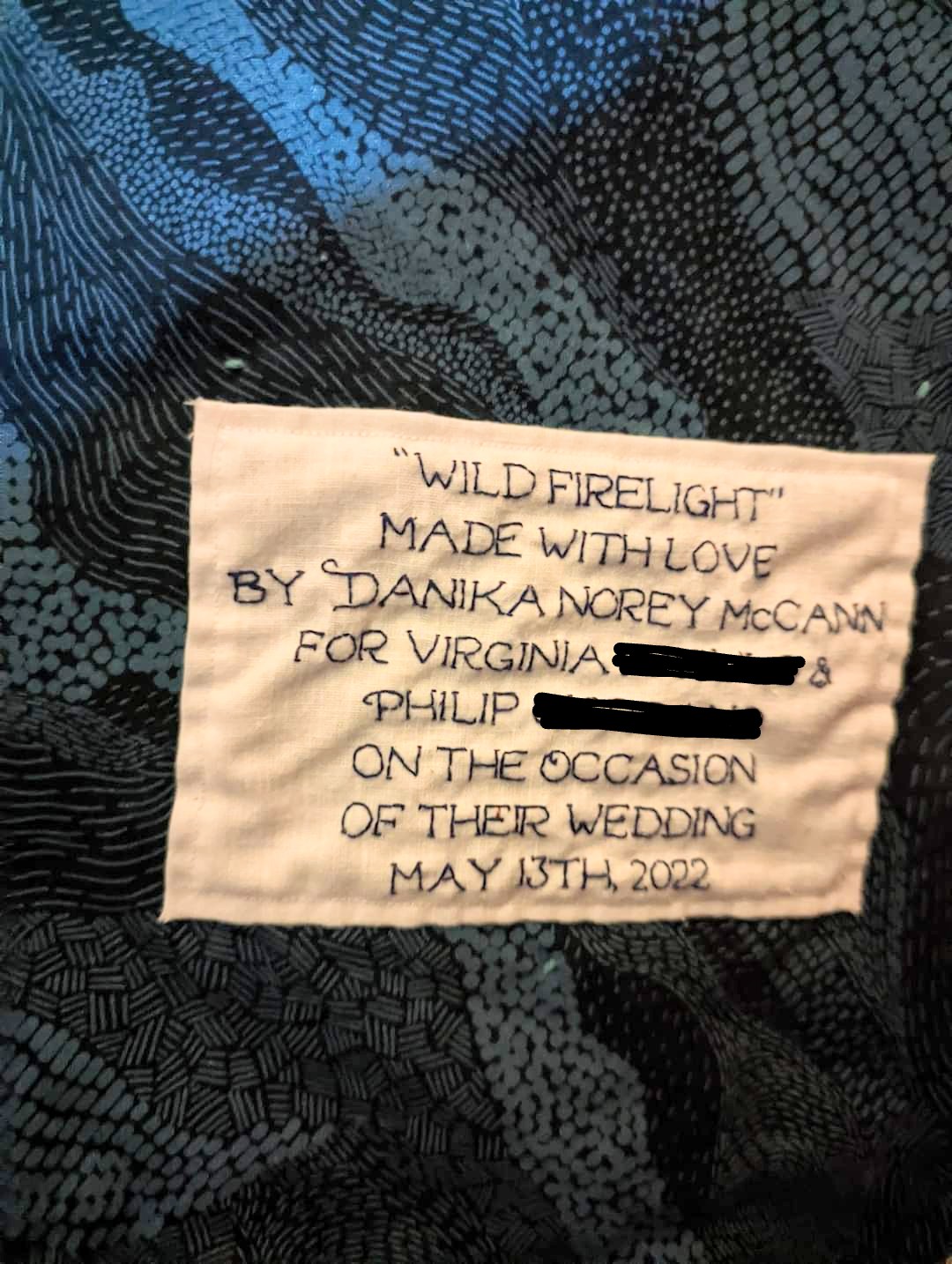
After binding, the label needs to be put on. I have all of my labels hand made by Anne Lemin of Quilted Lovelies in Texas. She embroiders them all for me and I absolutely love them. I hand stitch my labels on just before I’m going to wash the quilt. Remember: a Quilt is not finished unless it has a label on it!
Quilt Label
I ALWAYS wash my quilts before giving them to their new owners. I always try to do a pretty harsh wash cycle for a few reasons. I want to make sure the quilt will survive if someone accidentally puts through a regular, hot wash. So, generally I wash my quilts for their first wash in hot. I add color catchers in to the machine and I ensure they come out clean. I will repeat was until the color catchers are white. I do not want a quilt to run after its out of my hands. I also watch the time on the machine and DO NOT let it sit in the washer for more than five minutes. If its going to run, the dye sitting on wet fabric will set in a short amount of time, so you don’t want it to sit.
When washing a quilt, you’ll want to put it in on the gentle cycle in warm or cold. If you have a front loader, it can go through the whole cycle in there, but if you have a top-loader, the quilt CANNOT agitate. It can rip the stitching and cause lots of damage. If you have a top loader, let it fill and soak. As soon as it starts agitating, stop the machine. If it is very heavily soiled, grab your biggest wooden spoon and start smushing it (technically term, I swear) and then push the knob passed agitate to spin, close your washer and let it finish with a spin and rinse.
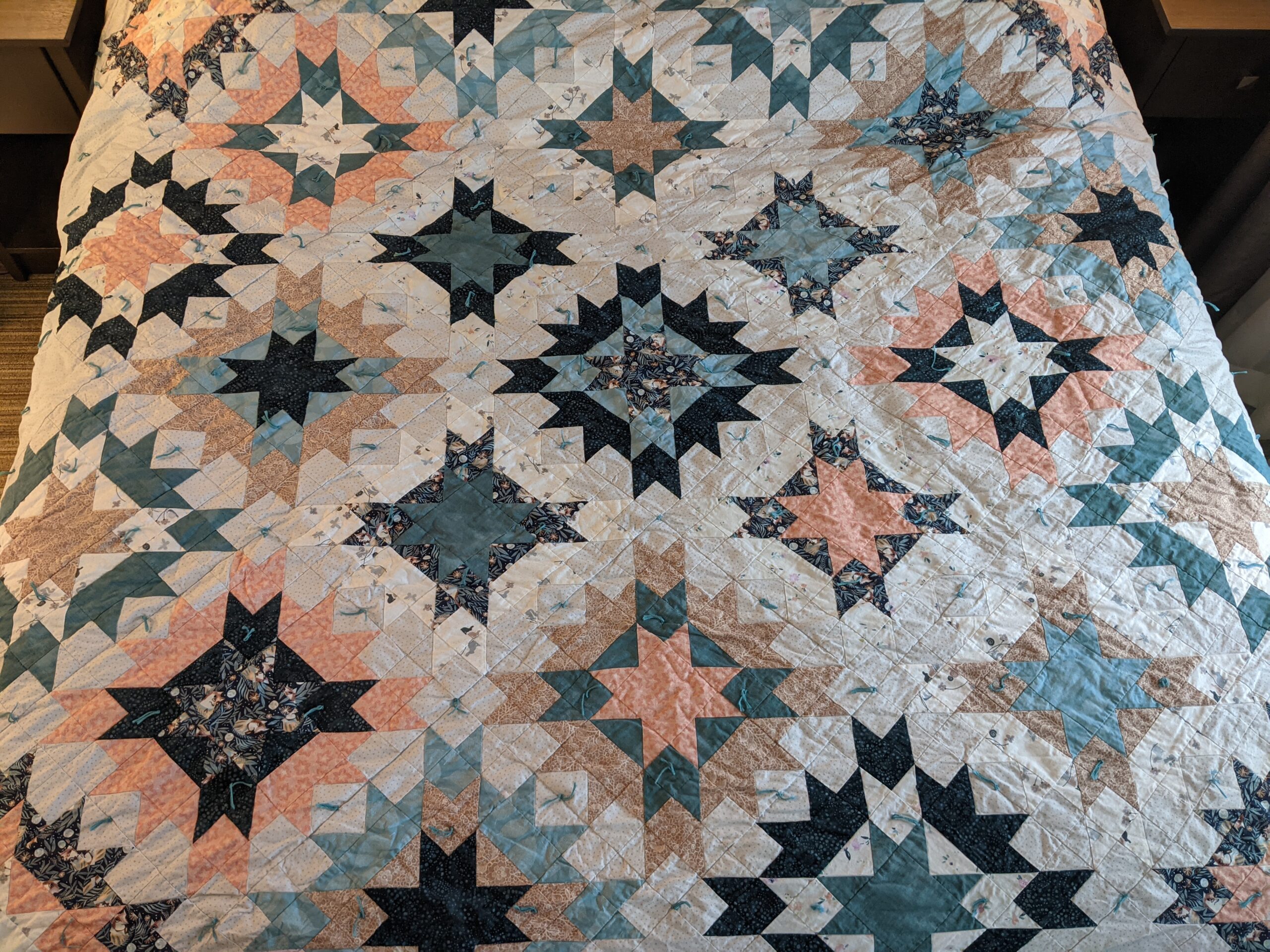
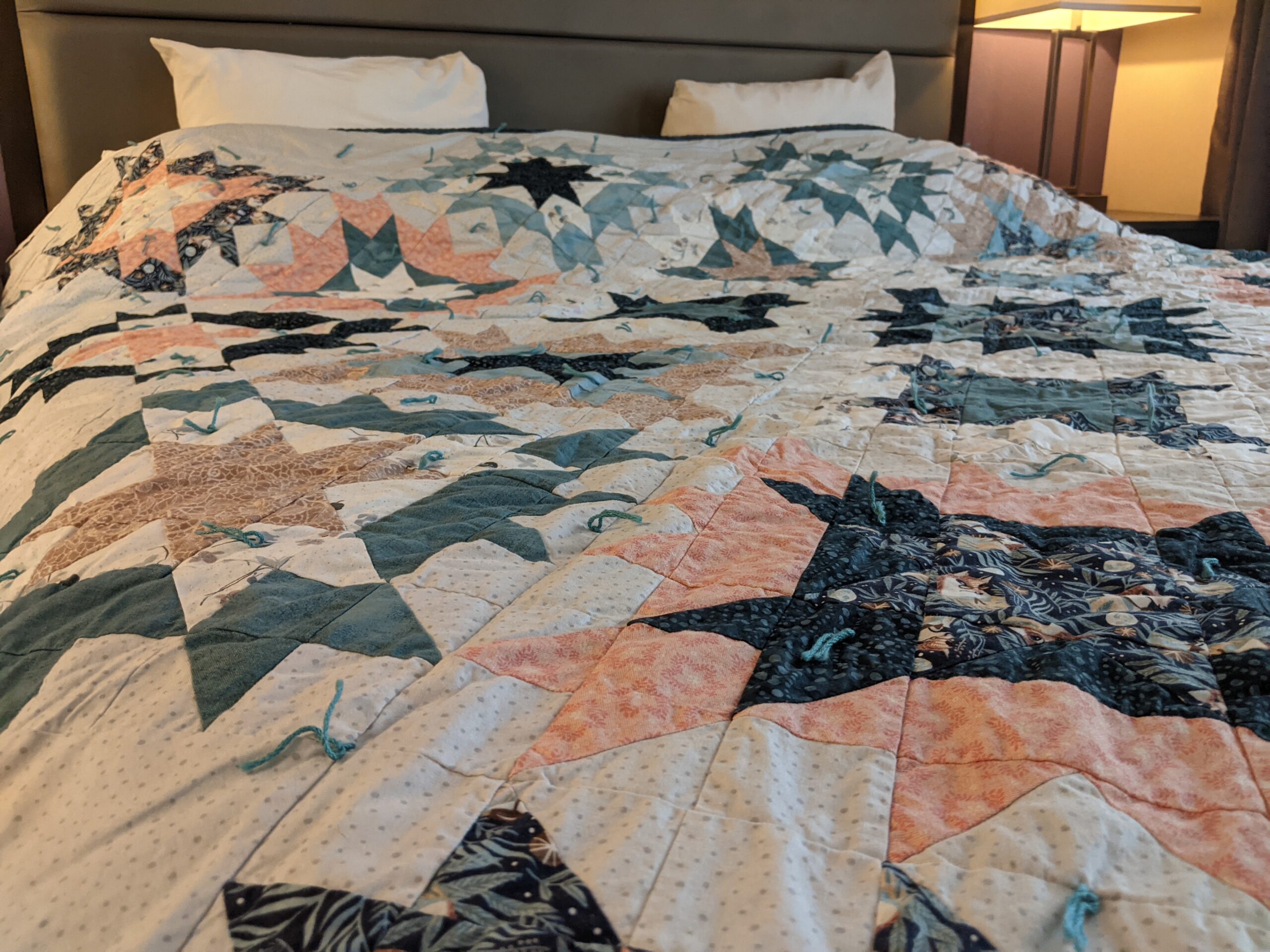
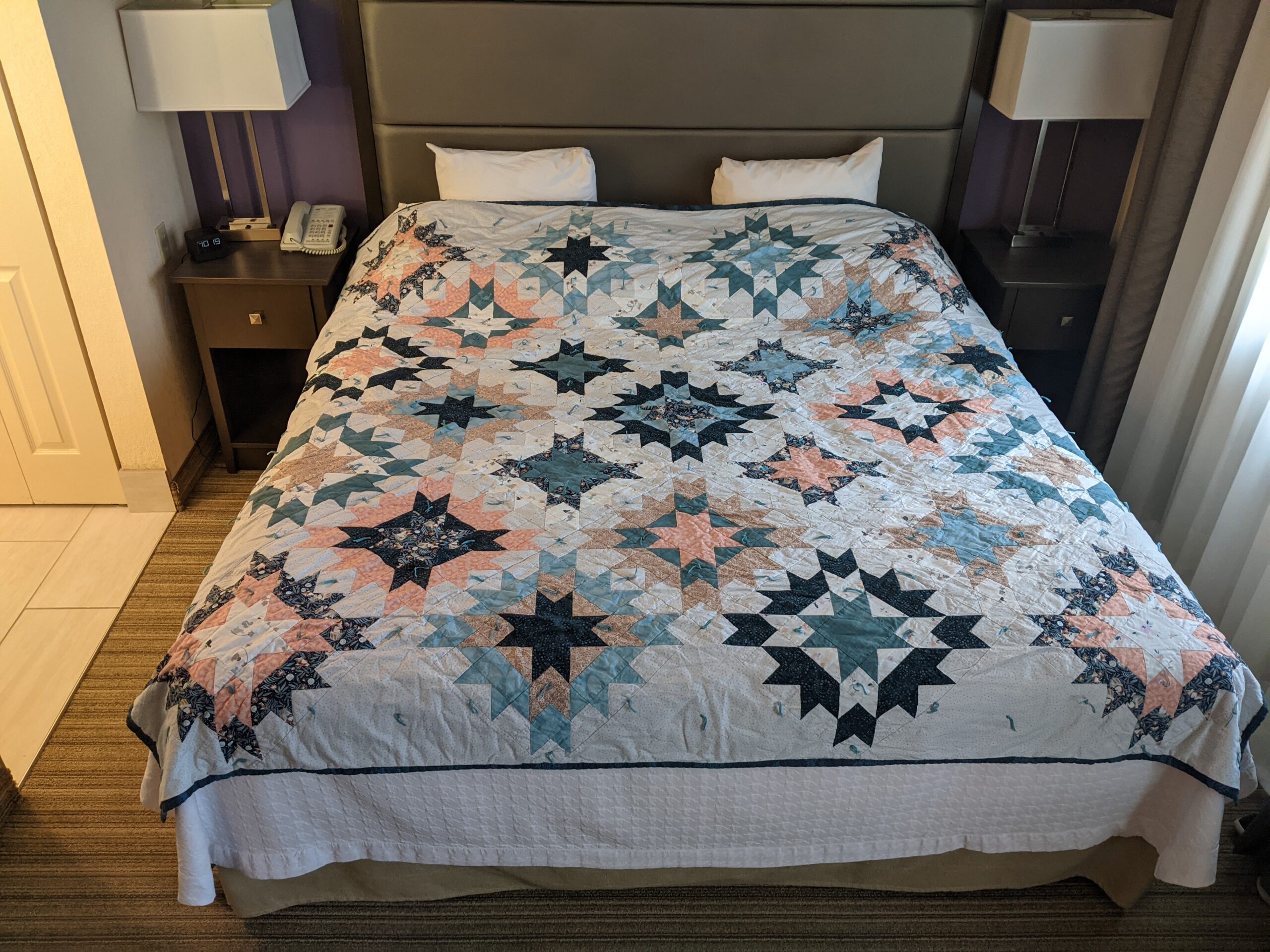
Finished QuiltFinished QuiltFinished Quilt
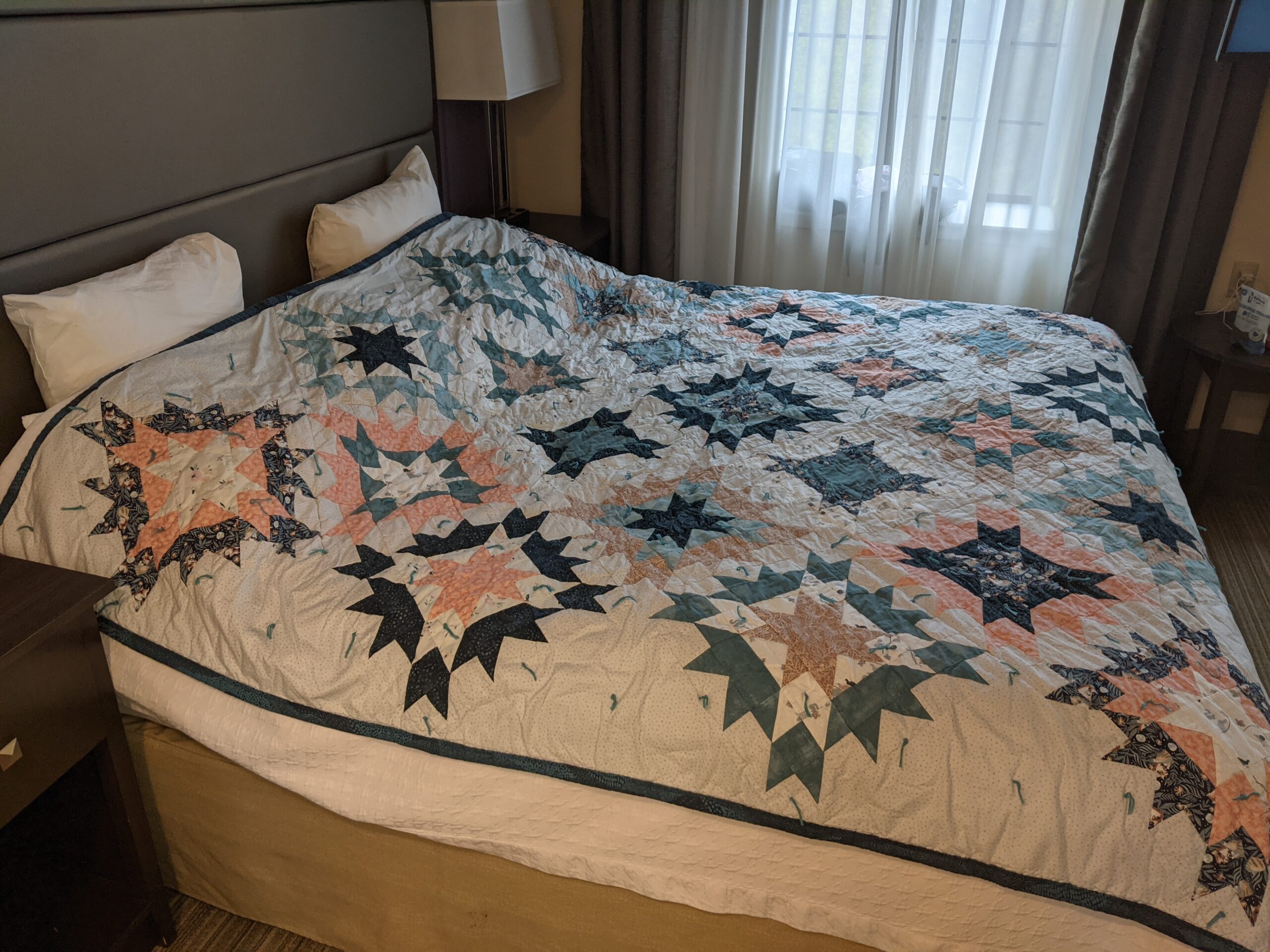
I’ve apparently made it my habit to photograph finished quilts in hotels. Here’s a few more photos for your enjoyment.
Here’s the details on Wild Firelight
Title: Wild Firelight Pattern: “Firelight” by Sharon Holland Designs, colors and finished size not to pattern specifications Size: larger than Queen, finished ~93″ x 93″ Fabric: Colors curated by me, purchased from Burkholder Fabric in Denver, Pennsylvania while at retreat Piecing: Machine stitched on Mavis, the Bernina 770QE, with Connecting Threads Essential 50 weight, 100% Cotton, in White Cutting: all by hand Quilting: Tied with Takhi Cotton Classic, 100% cotton yarn purchased at Cornwall Yarn Shop Backing: “Elements Earth” in Navy by Northcott Fabrics, 108″ fabric purchased from Beetle & Fred in Beacon, New York Label: Hand Embroidered by Anne Lemin of Quilted Lovelies, machine stitched by Danika to attach to quilt back Batting: Quilter’s Dream Finished Date: May 2022 Total Hours: 98 hours
Ham and Cheese? Peanut Butter and Jelly? Nope! How about a Quilt Sandwich!! Once the top is finished, you have a few options. If you have time (I definitely did NOT) you could prep your top for a longarmer or quilt the top yourself, either …
Next step after assembling all of the blocks is to assemble the actual rows that make up the Quilt Top. This was the layout (below) that I had come up with and labelled the blocks accordingly. To assemble the top, I needed to put the …
So, umm…let’s talk about this deadline. The Wedding was May 13th. The Quilt was done in time and gifted! She loved it. Having said that, I want to catch you all up on the rest of the process…..and yup, I’m totally going to make you wait for the end result. : P
I told you the next step was definitely to assembly line the rest of these blocks, and that is certainly what I spent the majority of my time doing. I know I mentioned it in the last blog, but remember: I had already invested over 20 hours of time before I even started using my sewing machine, and then had to assemble, press, trim and sort the Flying Geese units and Half Square Triangles….so before the actual blocks even started to get assembled, I was at 37.5 hours.
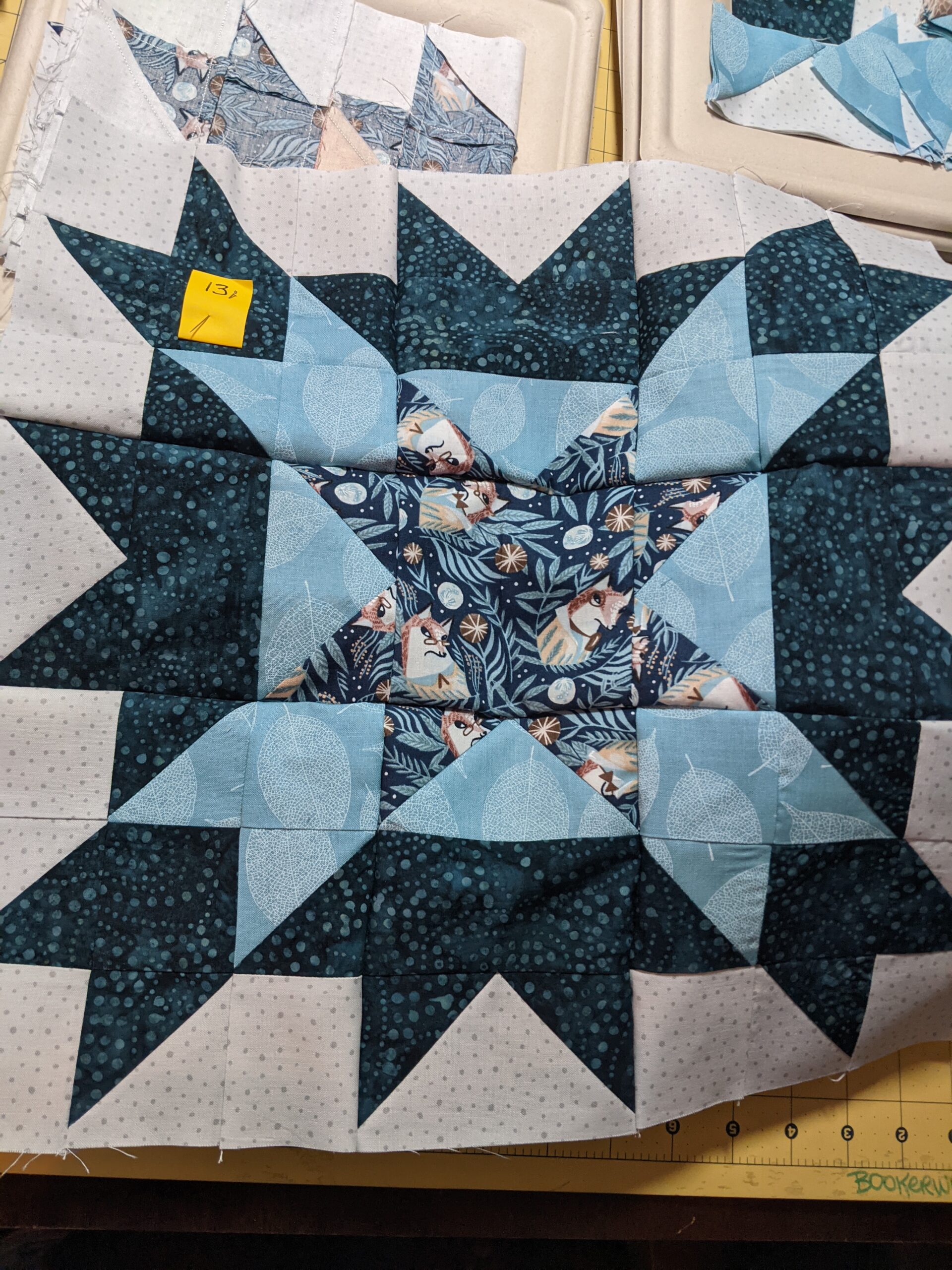
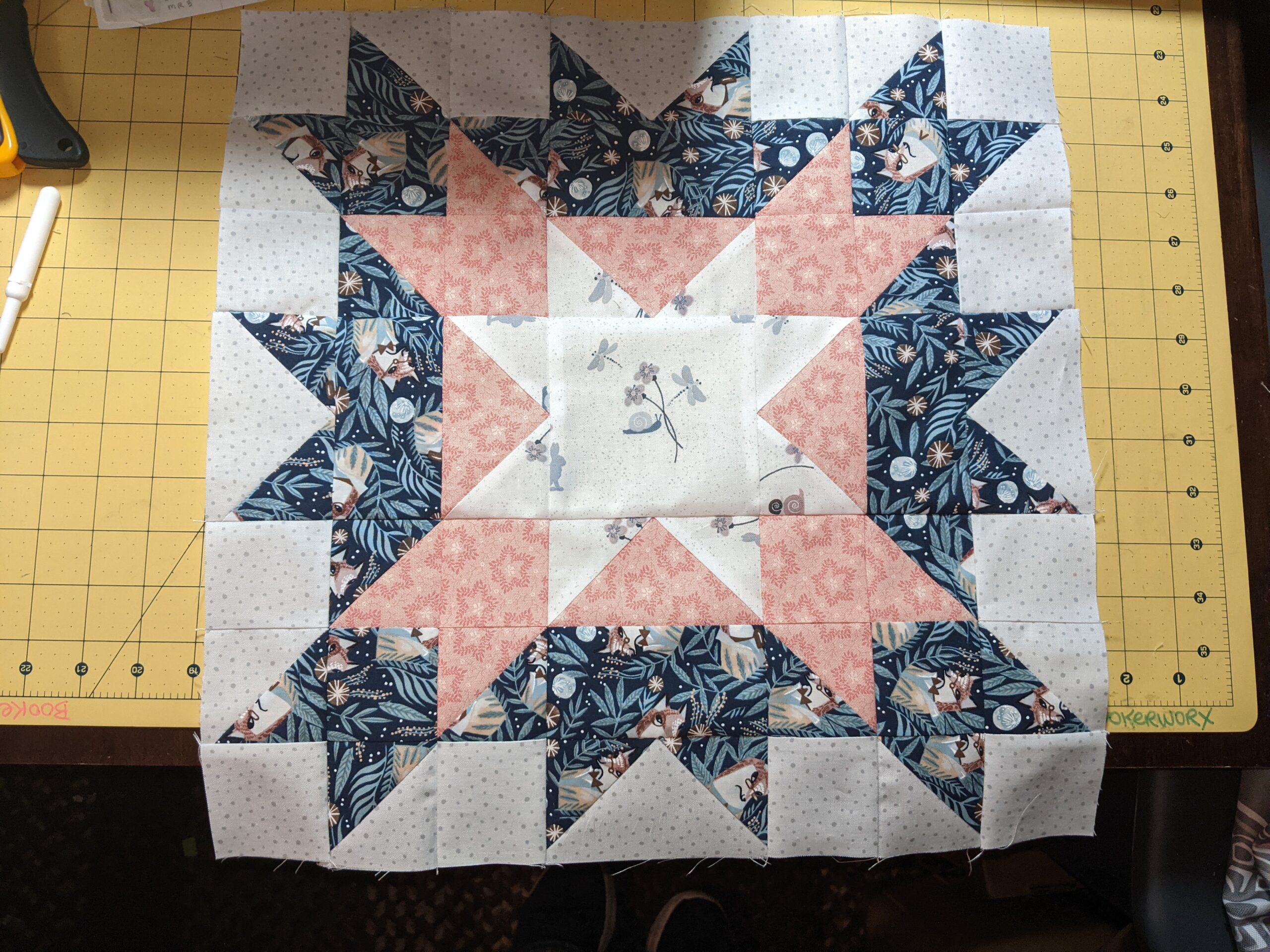
Here’s the test block (Block number 1) below. I’m going to post some of the other finished blocks below for your enjoyment.
Above you will see Finished Blocks 17, 13 and 9. They still need to be pressed, but these are the completed blocks.
Finished Block 5Finished Block 21
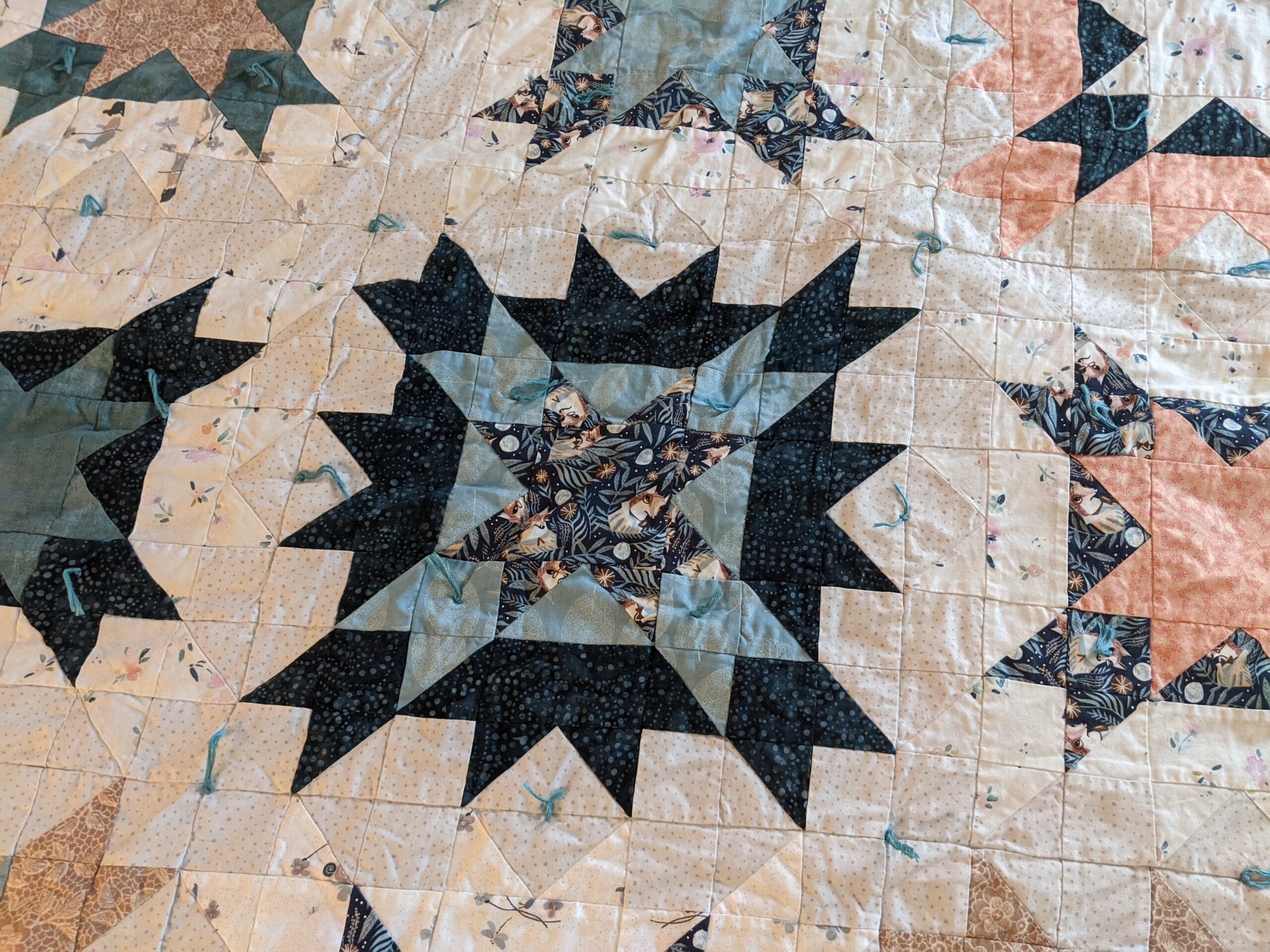
Above you will see Finished Blocks 5 and 21. As you can see the color combinations are all slightly different and all make wonderful additions to this quilt. I LOVE the way the colors are turning out. I’m really not sure which combos are my favorite yet, but I’m super happy with the way they are turning out.
Quilt Countdown: 28 Days As you know, I am creating this Quilt using a beautiful pattern by Sharon Holland called Firelight. I have altered the pattern slightly, in that, I am making it larger than the pattern’s largest size….so not a real modification, but definitely …
I’m adding a new Count Down up here. lol Quilt Countdown: 29 Days I want to take a moment and just say, that if you are starting out, please don’t get overwhelmed. I’m showing the whole process with this particular Quilt as its typical of …
I realize as I type this, that Part 1 of this Instruction was started in November (ooooh boy) and this Quilt’s deadline is May 13th.
I’d love to say that I’m just behind on the blogging part, but no….this quilt hasn’t been worked on since November. That’s okay. It’s being worked on now.
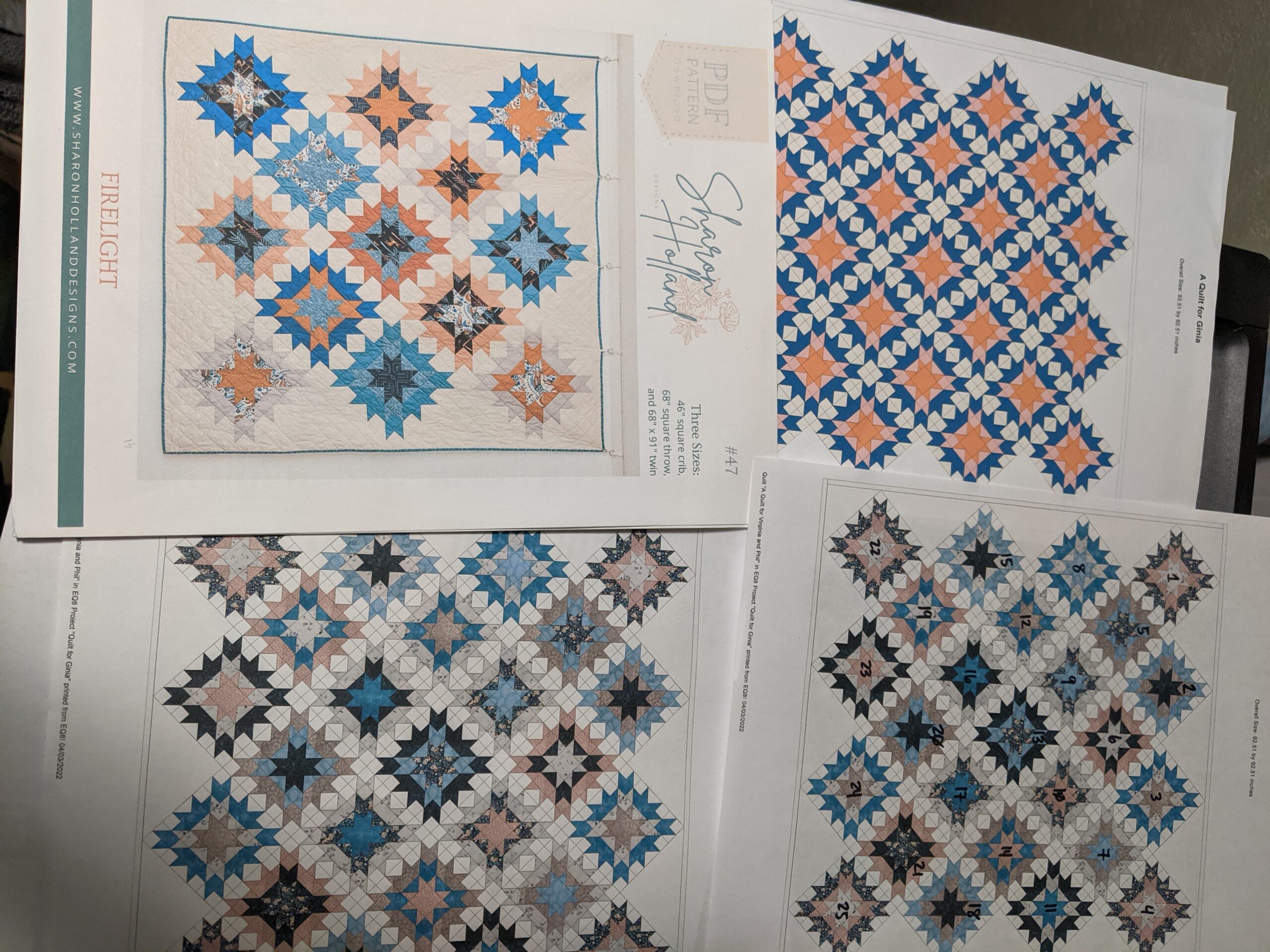
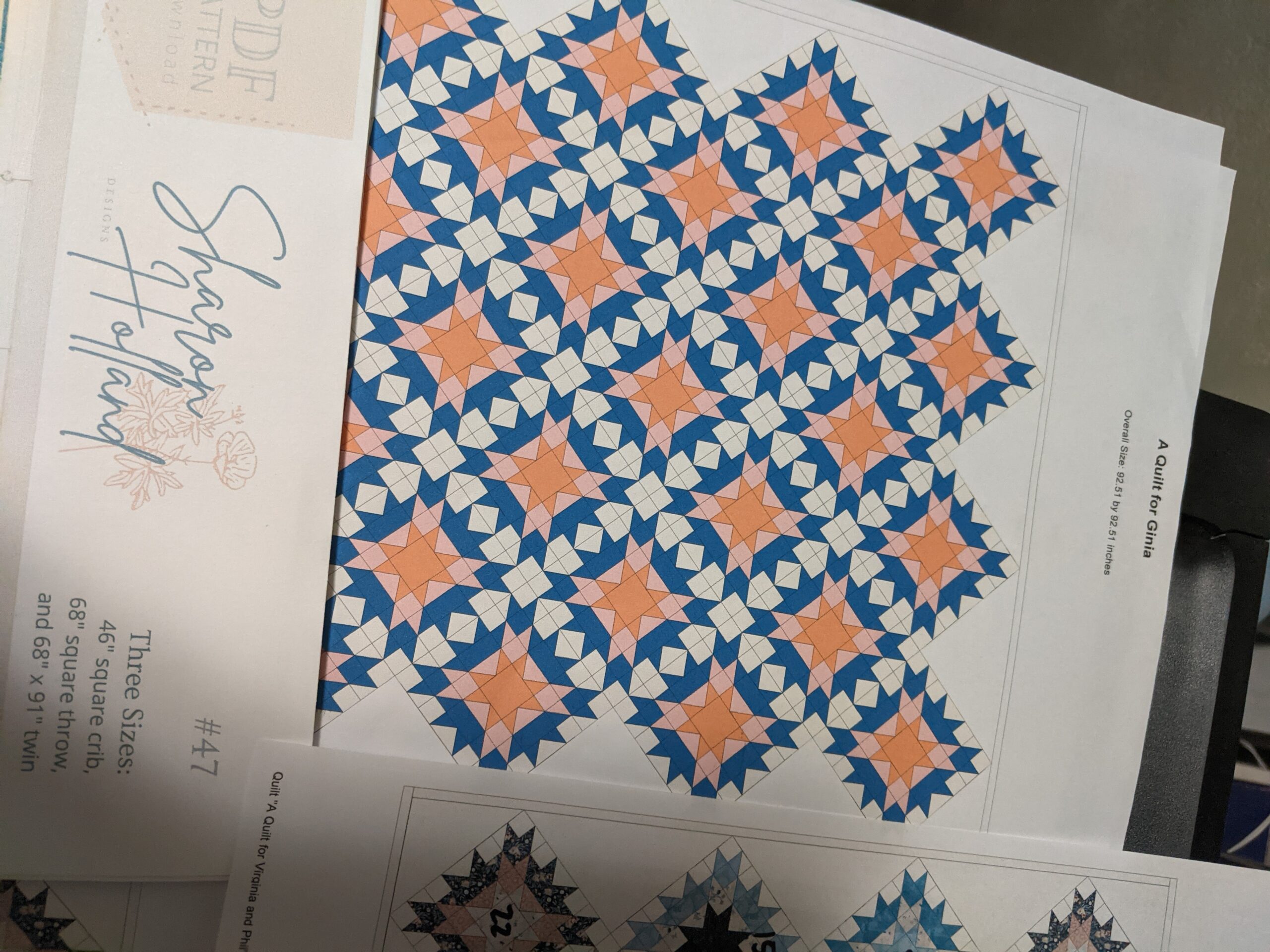
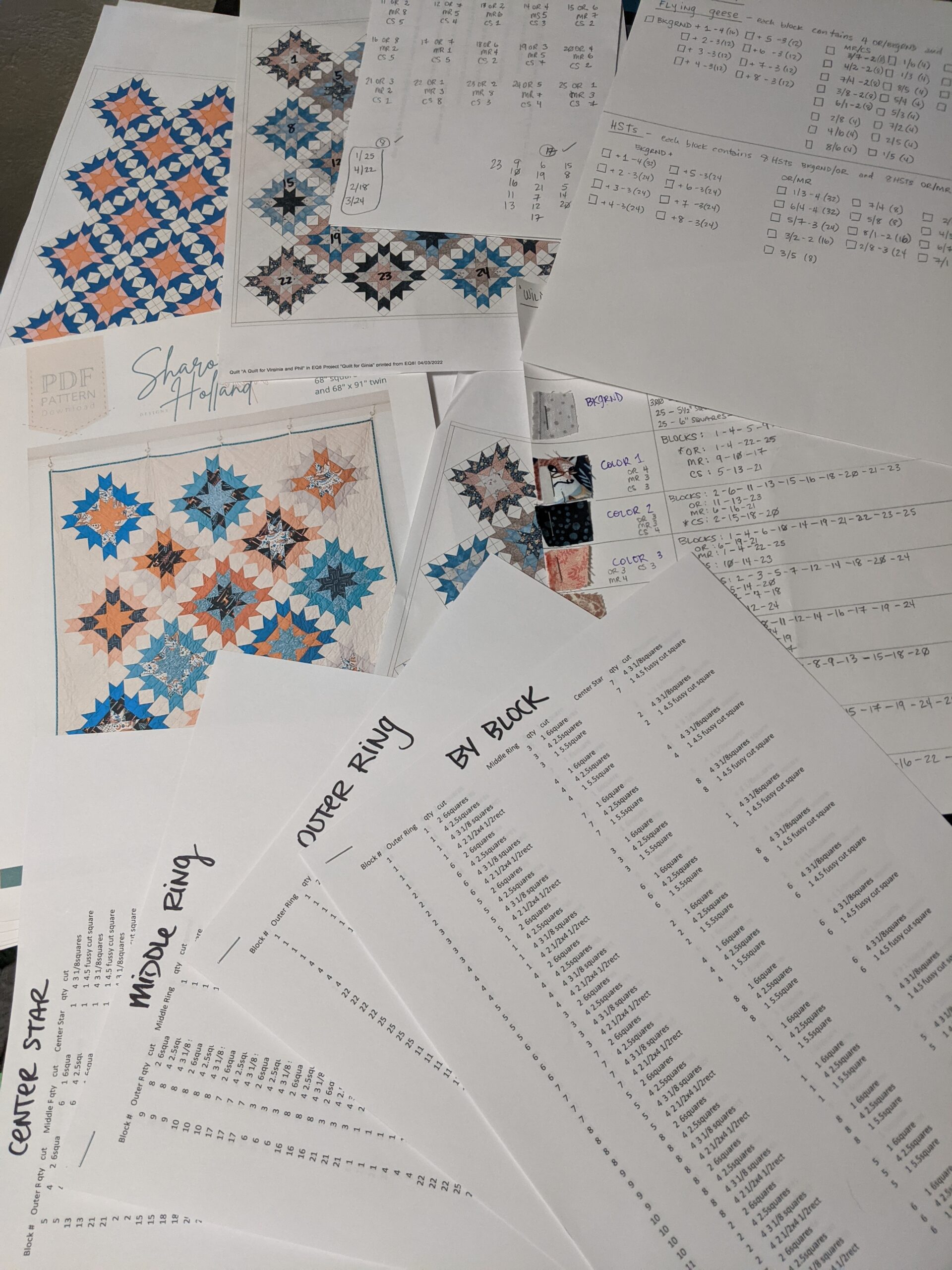
Ok, let’s talk Quilt Math!! I am a very visual and analytical person. I needs lists, spreadsheets and things to be visually laid out. As I told you earlier, this quilt is being made from a purchased pattern called “Firelight” by Sharon Holland. This pattern includes quilts in three sizes: 46″ square crib, 68″ square throw and 68″x91″twin. …well…this is for a Wedding. I need AT LEAST a Queen sized quilt. Let’s do some math!
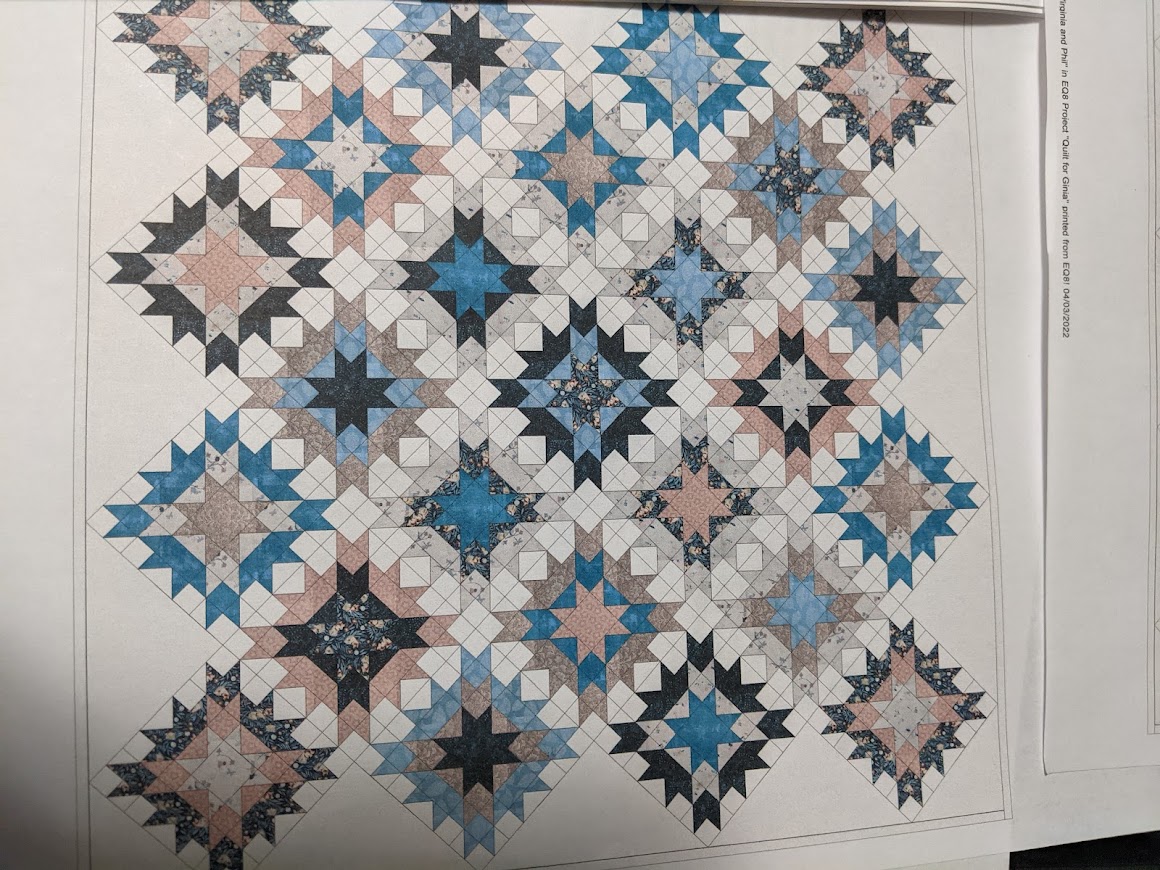
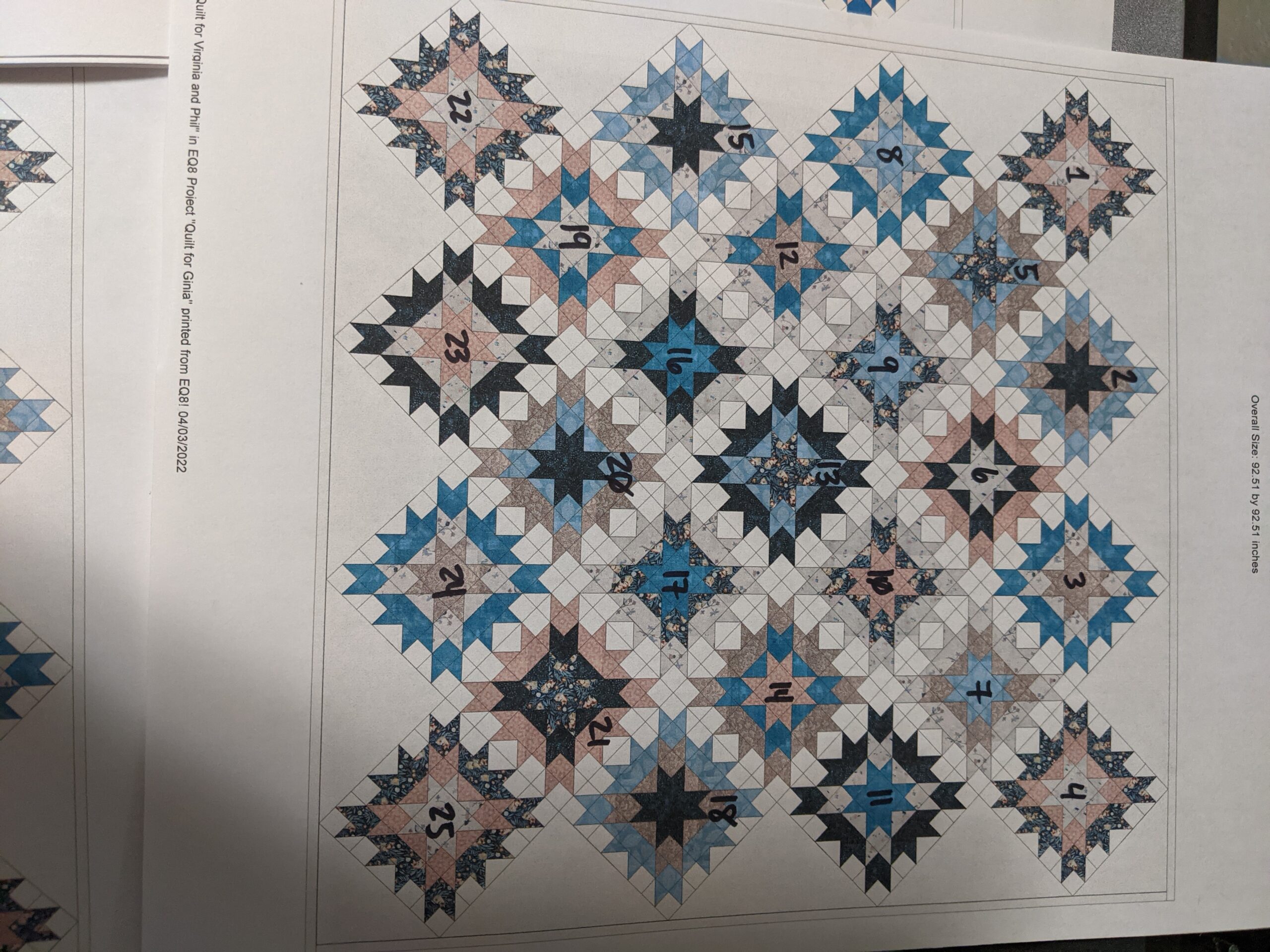
Original Pattern with my alternate layoutsInitial EQ8 LayoutEQ8 Layout with actual fabrics
When calculating yardage, I actually went with the twin sized quilt and doubled it. My initial layout (center photo above) has 25 blocks. The Twin layout from the pattern has 13 blocks. I doubled all of the required yardage and deemed that would be sufficient for my needs.
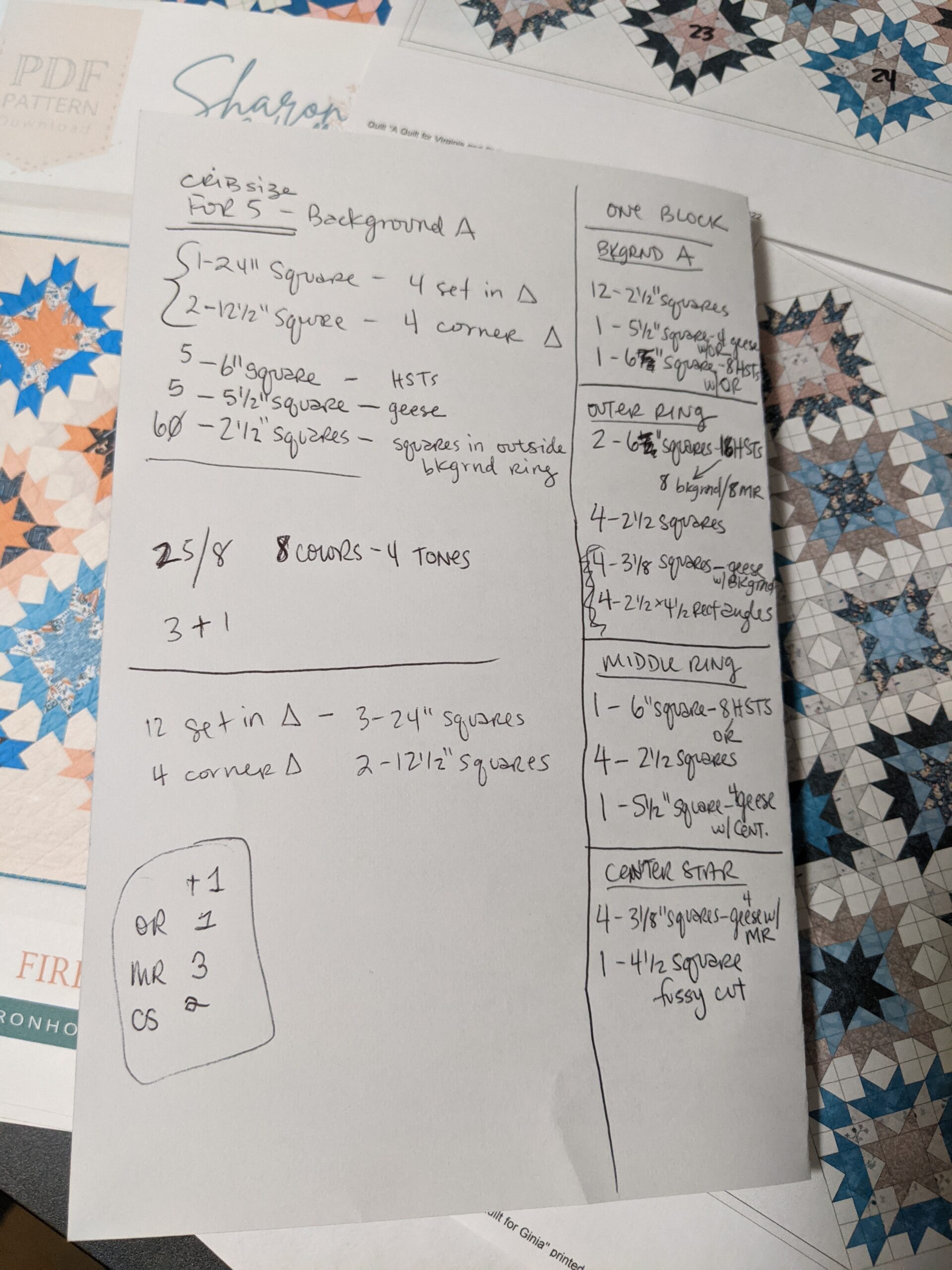
To calculate what I actually needed to cut, it was a bit more involved. I used the Crib size layout (five blocks) and used the pattern to figure out exactly what went in to just one block. (left photo below) After I figured all that out, I realized I couldn’t make an actual cut sheet until I figured out what fabrics were going into which blocks.
At this point, I needed to roll up my sleeves and commit to what fabric went where. I photographed my fabrics and put them into EQ8 and then scaled the photos and added them into my fabric Library. From there, I took the initial layout and started placing fabrics. Of course, 8 fabrics do not divide into 25 blocks easily. Each block is also made up of three parts, the outer ring, middle ring and center star. I decided to ensure that each of my 8 fabrics end up as three outer rings, three middle rings and three center stars–giving me 24 blocks. Then I decided to “feature” three different fabrics to be the extra outer ring, middle ring and center star.
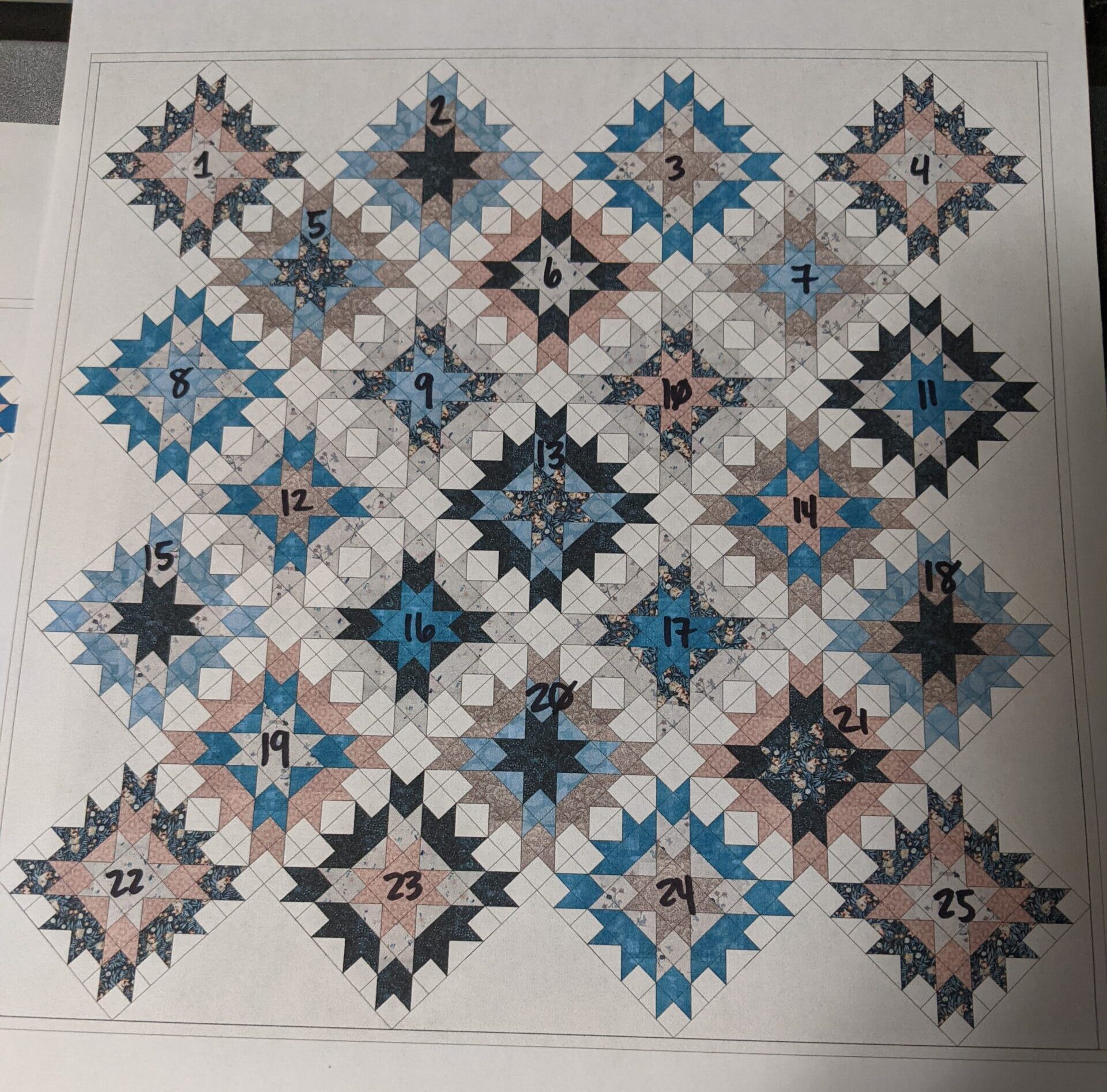
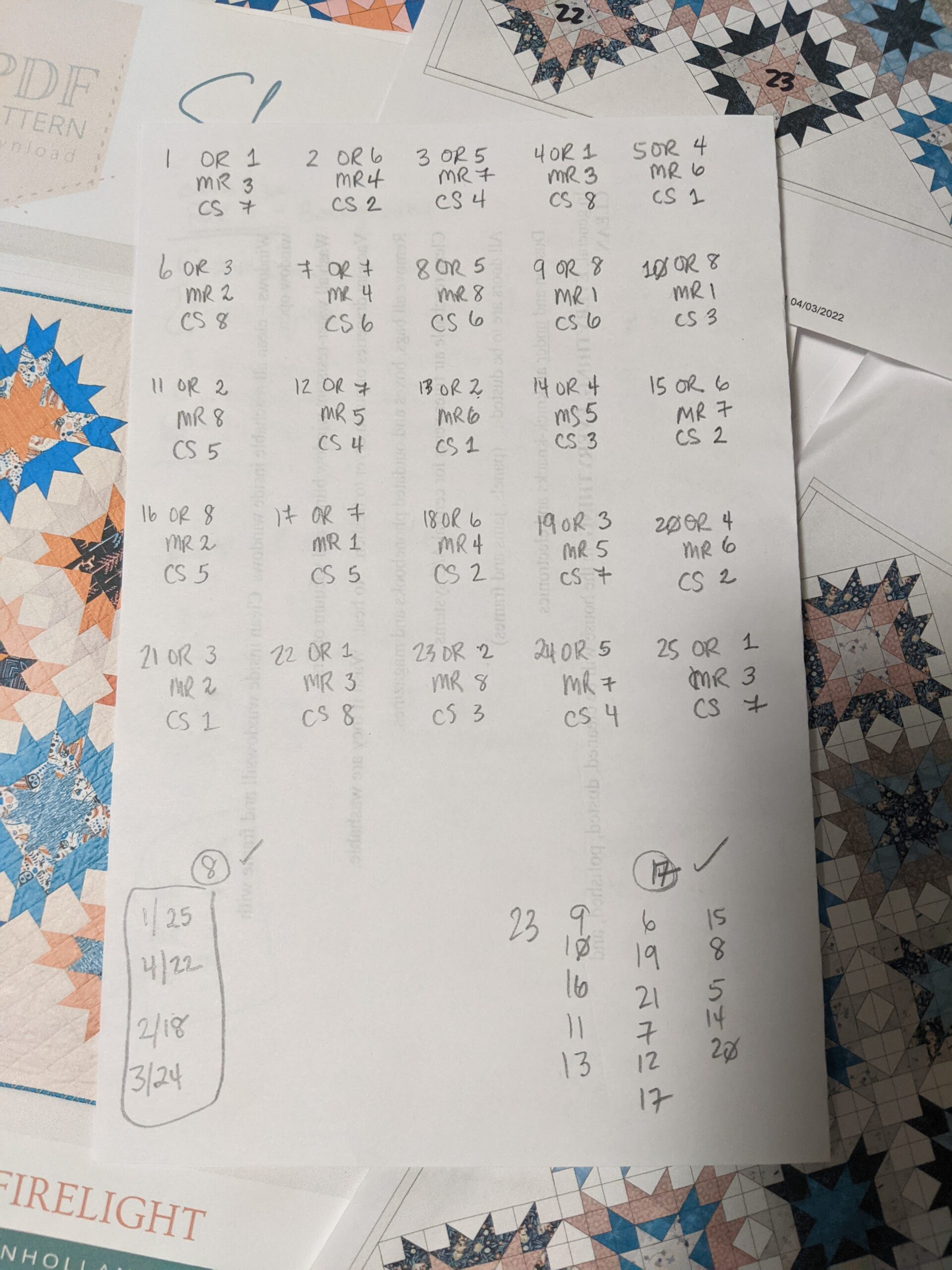
Once the fabric was laid out in EQ8 (right photo above), I started on my cut sheet. It was then that I realized it would be easier if I knew what each blocks color combo was. SO….I printed another copy of the Layout and then numbered the blocks from 1 to 25 with a Sharpie (right photo below). I then set out to make that list of block color combos. (center photo below)
Breakdown of one block for cutting, scratch paperBlocks 1-25 Fabric Combo, scratch paperNumbered Blocks
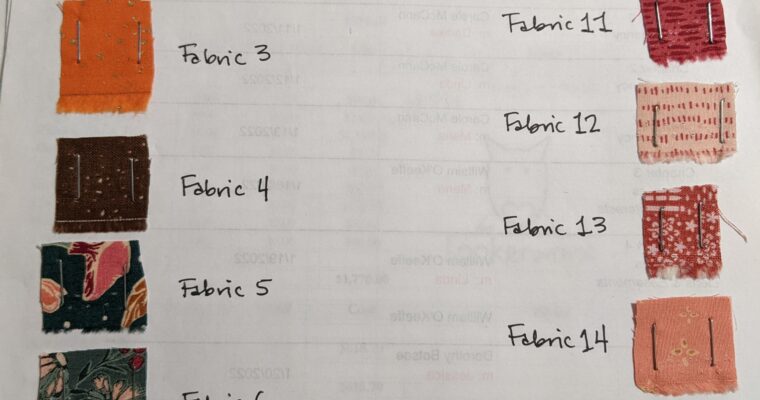
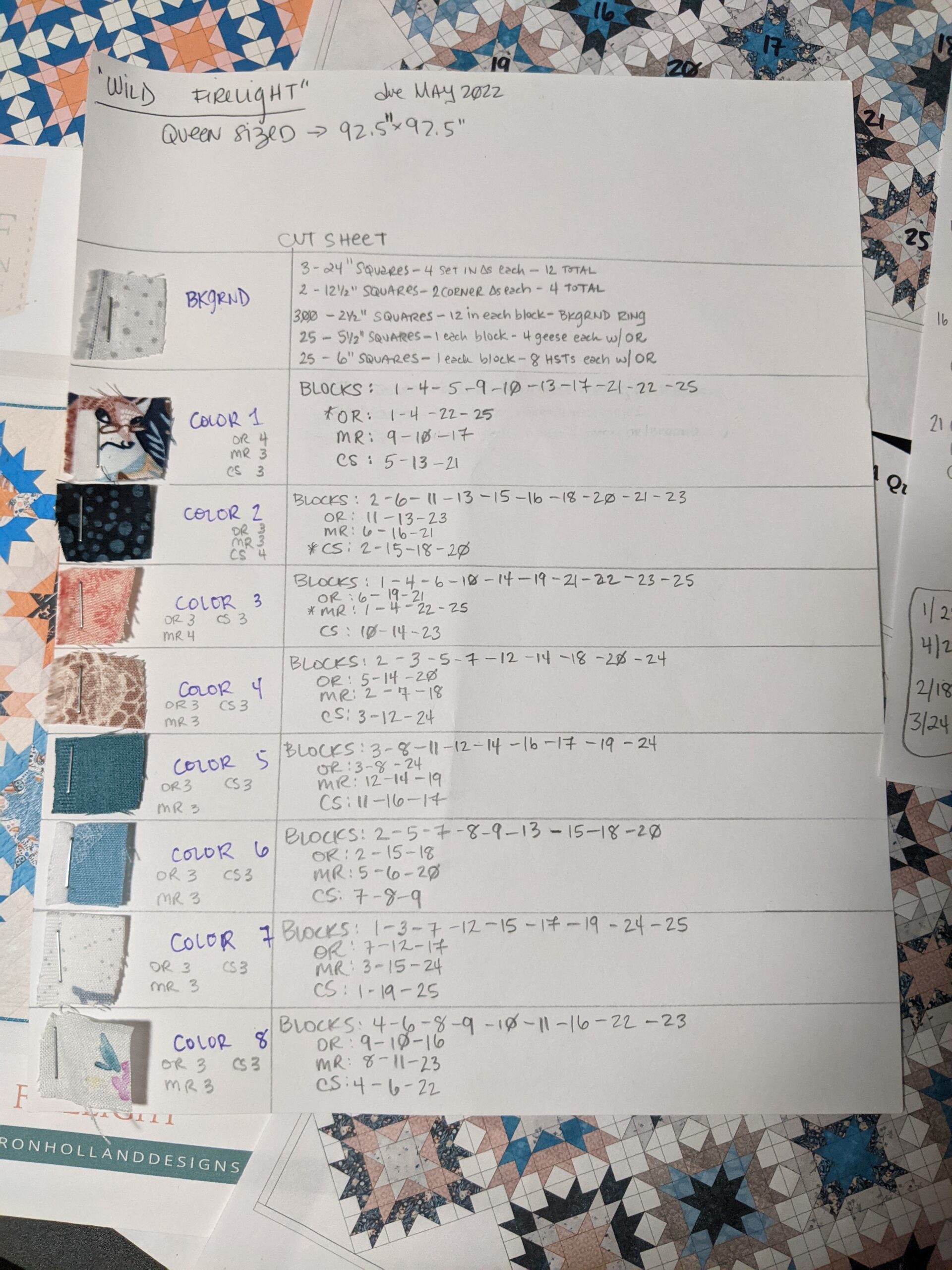
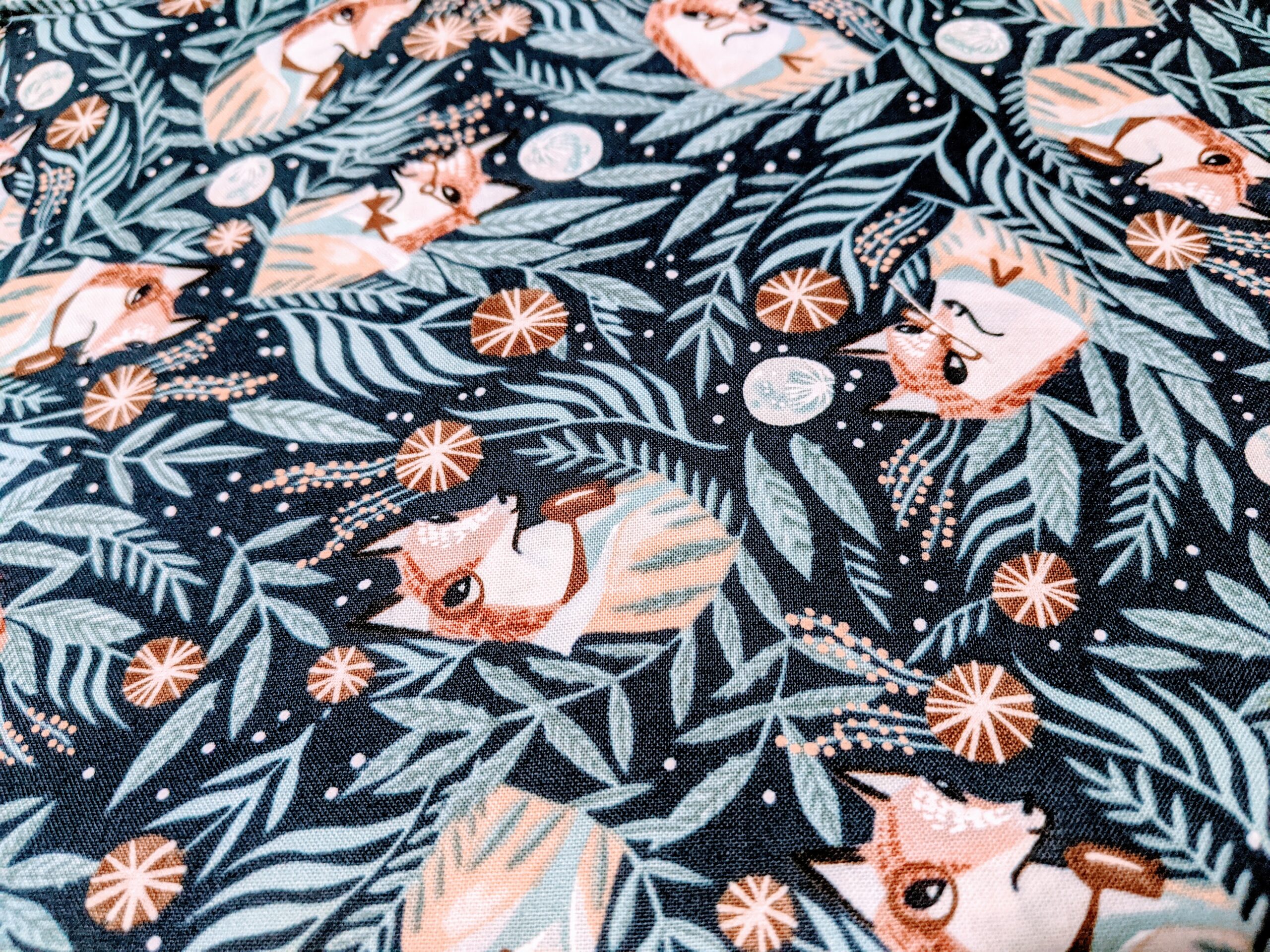
Once that was all done, I made my Fabric Cheat Sheet. (large photo below I take a small swatch of each fabric and staple it to a piece of card stock and label the fabrics. This always helps me keep my fabrics straight and helps me notate a pattern. I do this with almost every quilt I make….I think my only exceptions are scrappy quilts. I find this really helps my thought process and also ends up being a great record to keep after the Quilt is out of my hands. I should get better about writing the fabric details down as well. On this particular Fabric Cheat Sheet, I also wrote out what blocks the fabric is in, and where in the block it goes (Outer Ring, Middle Ring or center star).
Fabric Cheat Sheet
Definitely try to make a Fabric Cheat Sheet for the next quilt you are working on. I include it many of my patterns and highly, highly recommend the process.
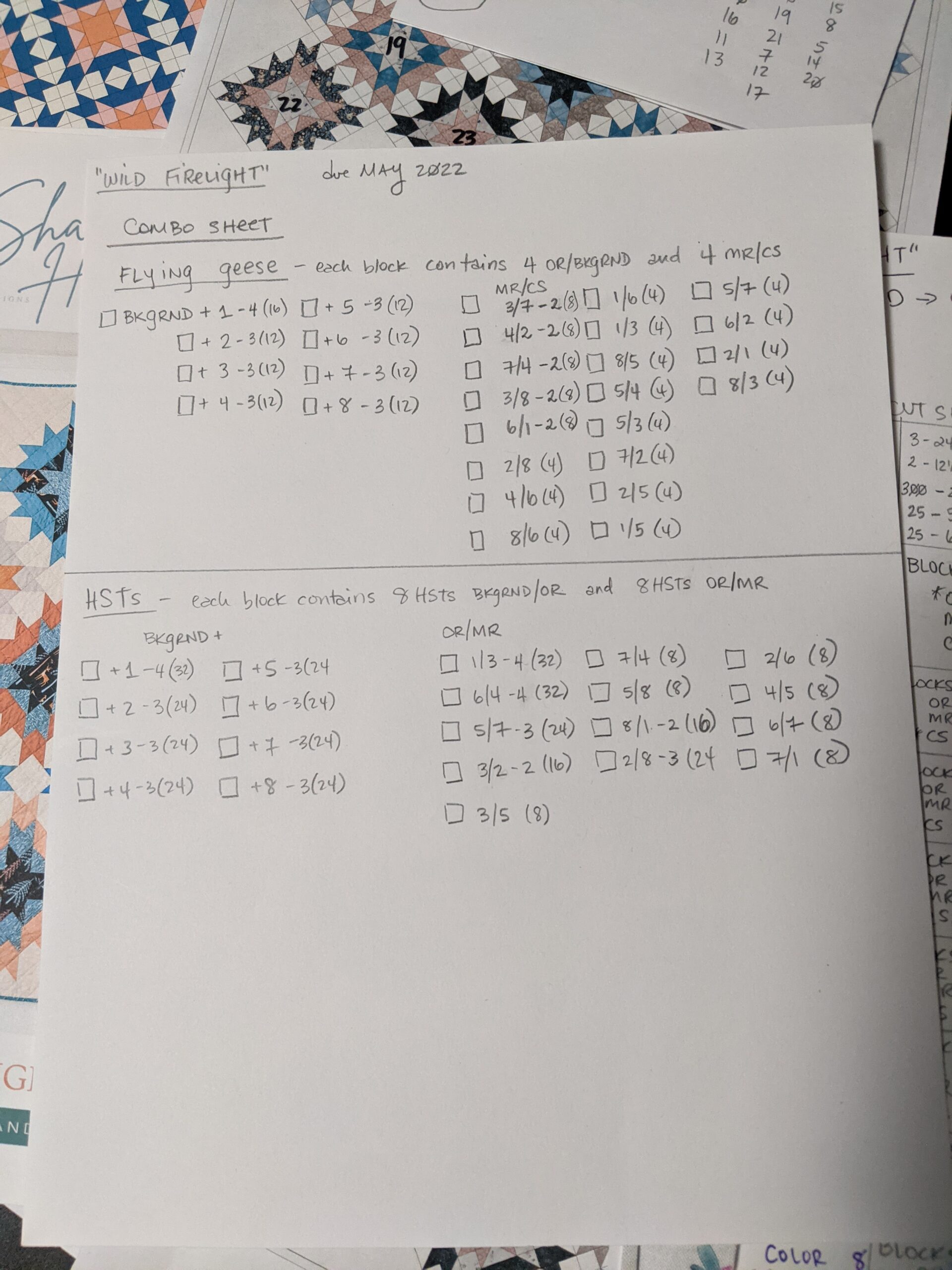
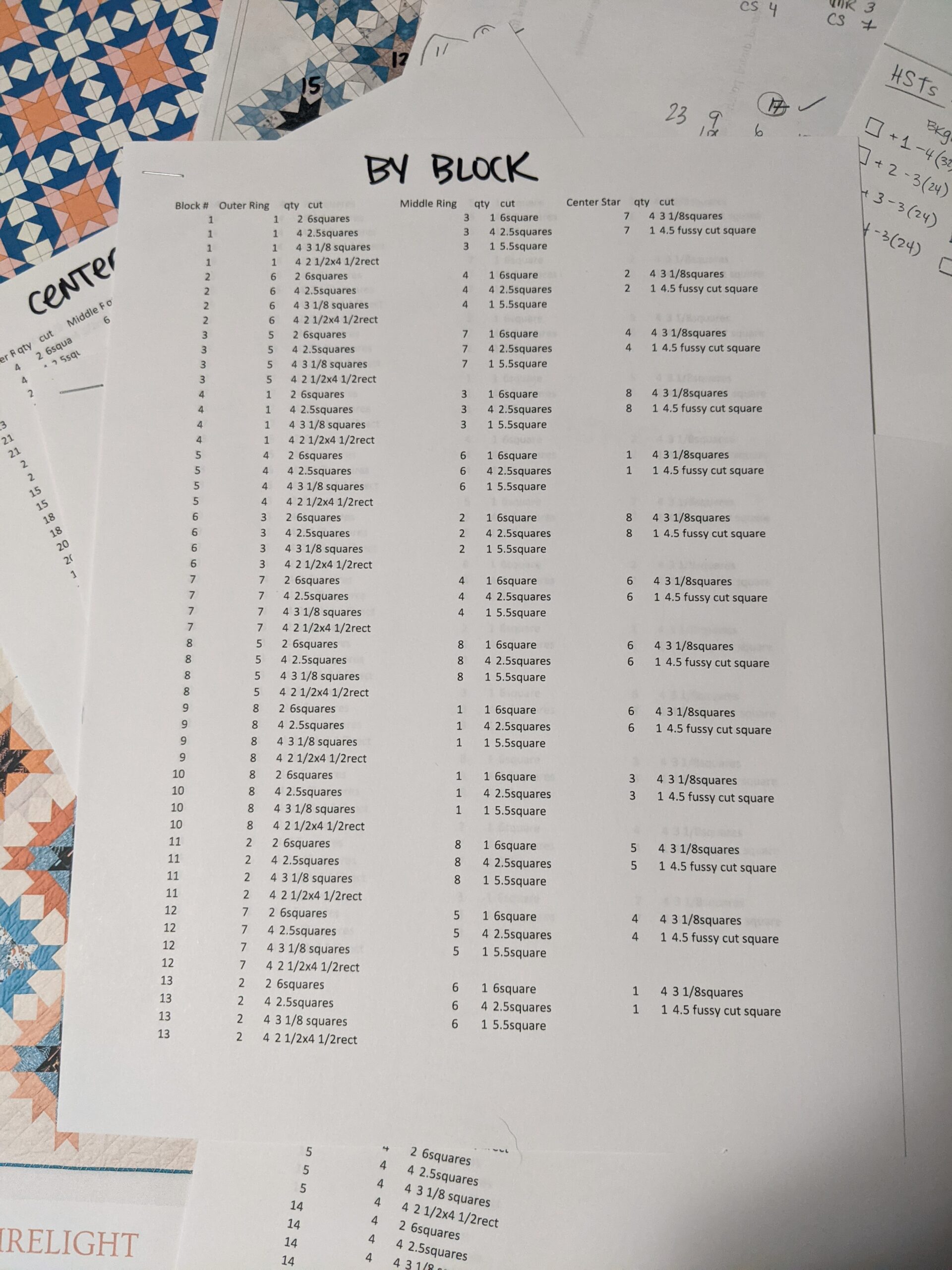
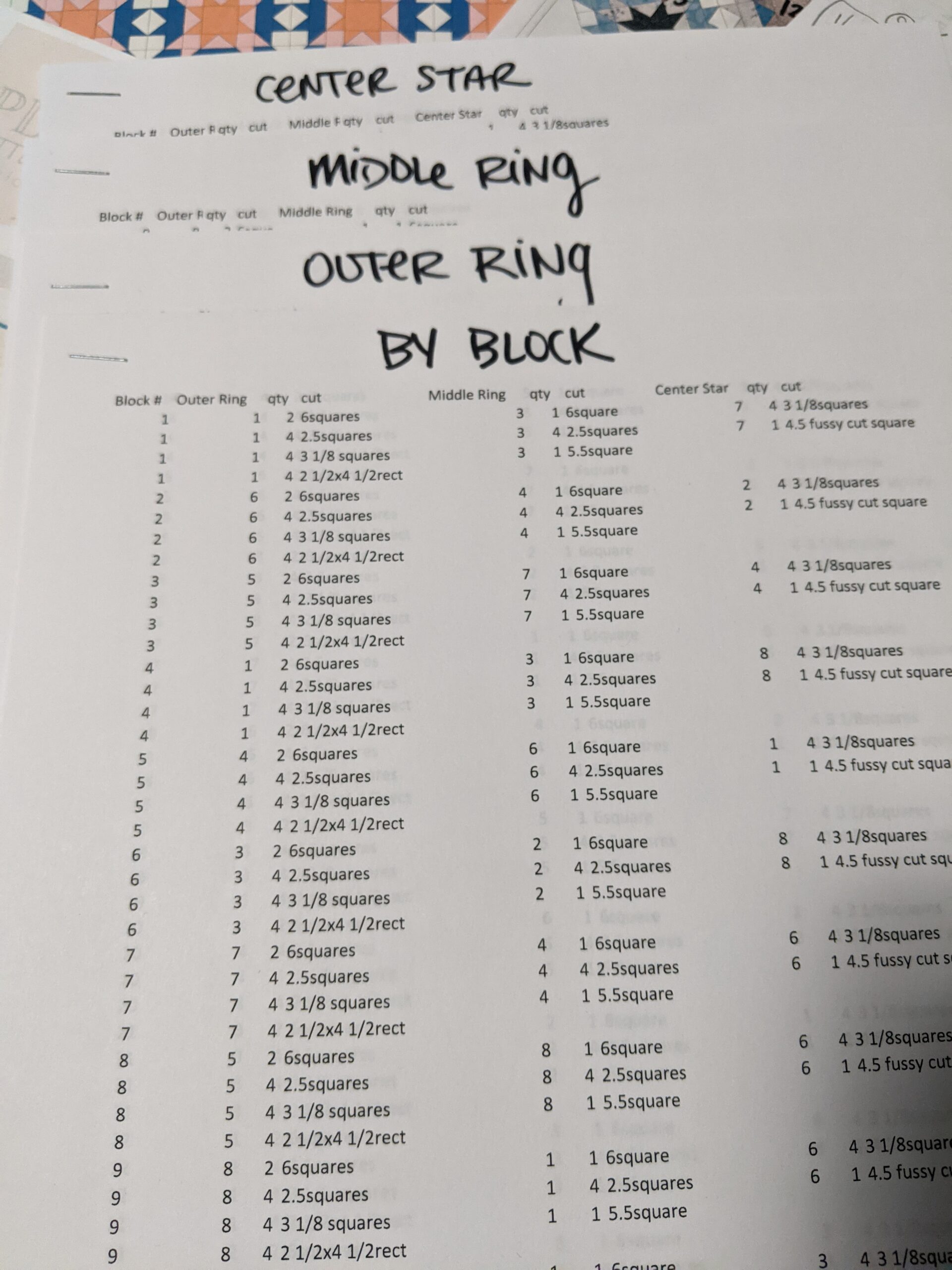
Combo SheetFirst SpreadsheetAdditional spreadsheets turned into cut sheets
Once all that was squared away, I realized that there is a ton of little pieces in each of these blocks, and writing it all out was going to stink. This calls for a Spreadsheet!! I opened Excel and created a quick spreadsheet that included my block number, the outer ring fabric color, what size and quantity needed to be cut for it, the middle ring fabric color, what size and quantity needed to be cut for it, the center star fabric color, and what size and quantity needed to be cut for that. I printed that out (center photo above) and then sorted my spreadsheet by fabric color for each of the three sections (outer, middle, center star) and printed those out, quickly making cut sheets for each fabric color. After finishing that, I opted to make one more List for myself: Each block in this quilt contains two different flying geese units, one with the outer ring fabric and background fabric and the second with middle ring and center star fabrics. Each block also contains two sets of Half Square Triangles, one with the outer ring and background fabrics and the other with outer and middle ring fabrics. (right photo above)
Because some block color combos repeat, I felt it would be most efficient to have these combos listed so that when I cut and sort my fabrics, I can put these color combos together more quickly. This particular pattern does 4 at a time flying geese and 8 at a time Half Square Triangles, so once I cut everything out, I can use this Combo Sheet (left photo above) to quickly sort those.
All of this work took me three hours. I sat down in one session to do it all. I find when you do this kind of calculating, it’s best to do as much as you can in one session, because if you have to get up from it, it takes you twenty minutes to figure out where you left off to get started again. Why spend the time on this? Well, this three hours spent here means I don’t have to spend ANY time figuring out color combos, using a design wall to “play” with my fabrics or figure out what fabric to cut what size. It’s all been done now. I’m not knocking a design wall at all, but this particular quilt would take WAY TOO MUCH time to do that way….time I do not have. All this Quilt Math also means I can cut in more than one session if I need to…which is good, because this quilt has a lot of cutting.
ALL the Quilt Math
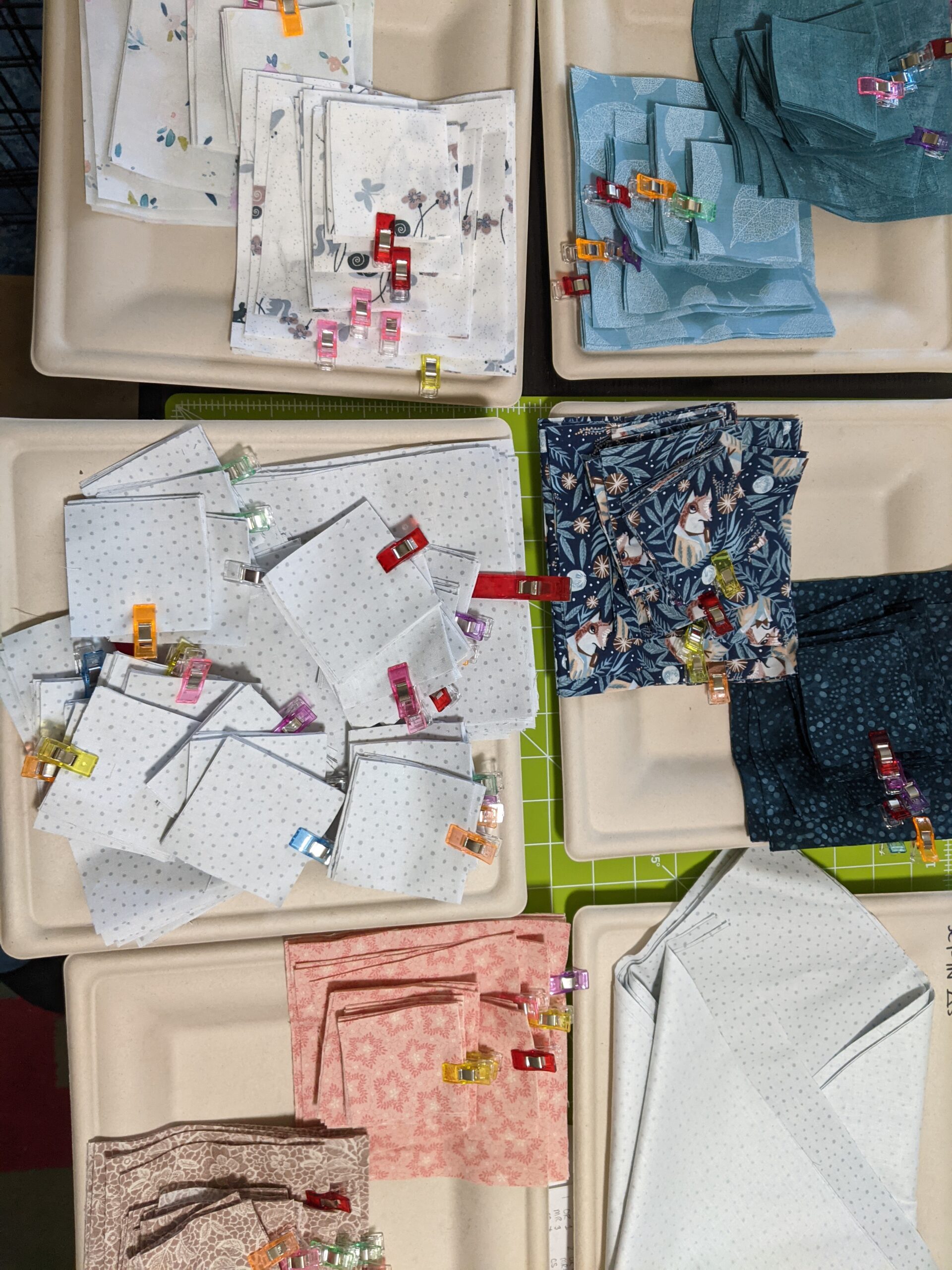
So, this is all the Quilt Math for this quilt….now named “Wild Firelight.” Next step: Cutting. All the Cutting. Did I mention it’s a LOT of cutting? And then Sorting…..all those Combos and blocks need to be organized so that sewing can happen in assembly line fashion. My plan? Make Block #1 fully to ensure all is correct, and then move forward with an assembly line that would make Mr. Ford himself proud.
Hour Count:
Previous Hours: 10
Breaking down Pattern and Adjusting Size, Color Charting, Cut Charts, Fabric Layout, Quilt Math: 3 hours
Total Hours so far: 13
Next Step: Cutting and Sorting Combos and Blocks, “Test” Block #1
I am often asked about the whole entire process of making a quilt. In times B.C. (Before COVID), in my Sampler class, I taught the entire process and we even finished one whole quilt, but not every one has the time to commit to such …
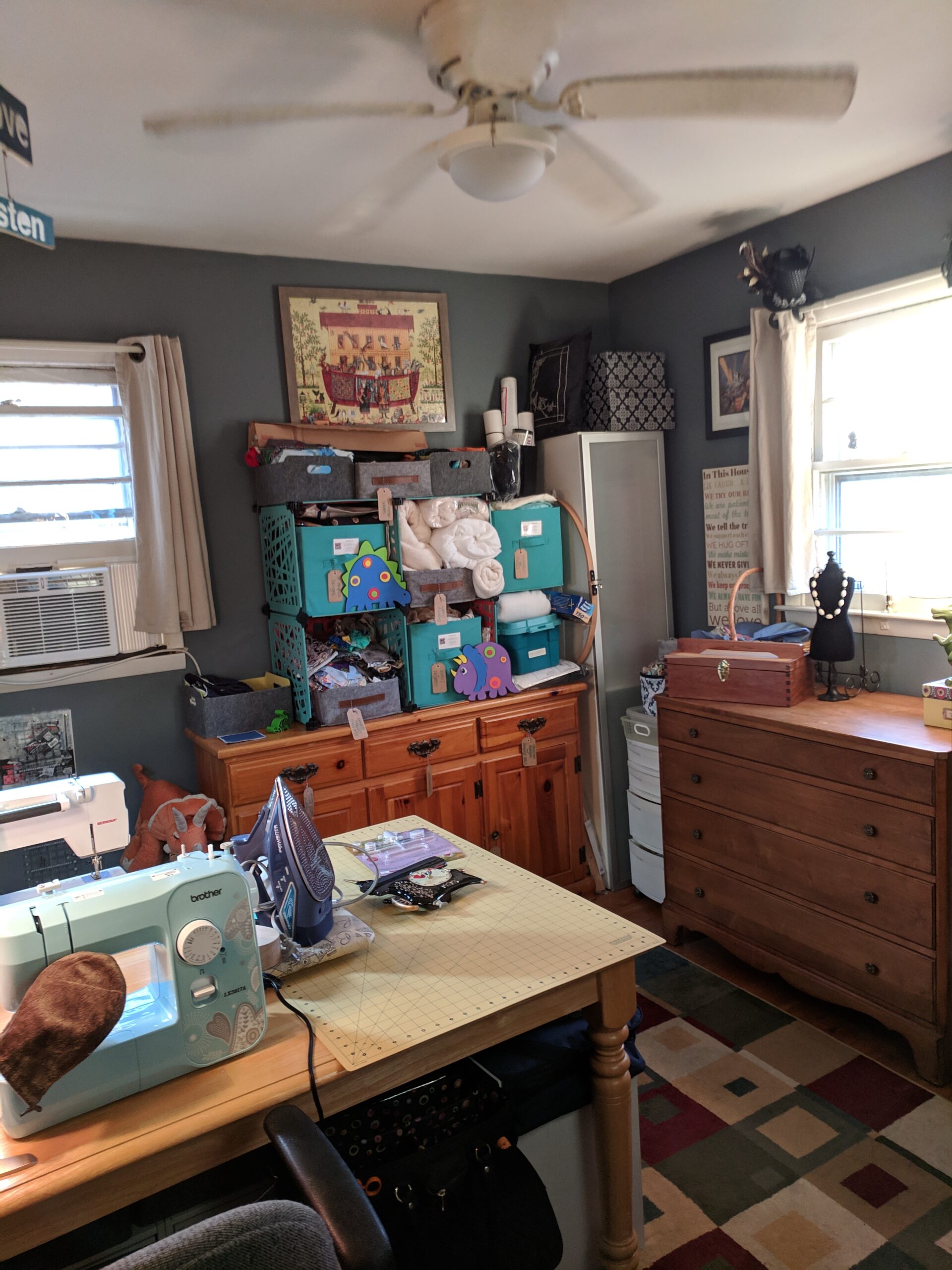
I get a LOT of people asking about my Studio space. I’m going to show off my old Studio here. Remember that what works for one person, may not work for another. I have found that I have adjusted, tweaked, rearranged, added and removed things …
If you’ve been following my Saga of the Quilt Seeds (ooh look! a conveniently placed link to that article right here. lol) you’ll know that I was trying to finish up a large quilt for my cousin’s wedding along with a baby quilt for my other cousin (his brother) all before a family wedding in August.
I’m not sure how it all managed to work out (well…caffeine, persistence and sheer willpower helped…) but we actually got it done! I say “we” because my loving (and very well-trained in being my quilting “sous-chef”) husband helped tremendously. There is simply no way this all would have gotten done without him…a statement that is true in most things in my life.
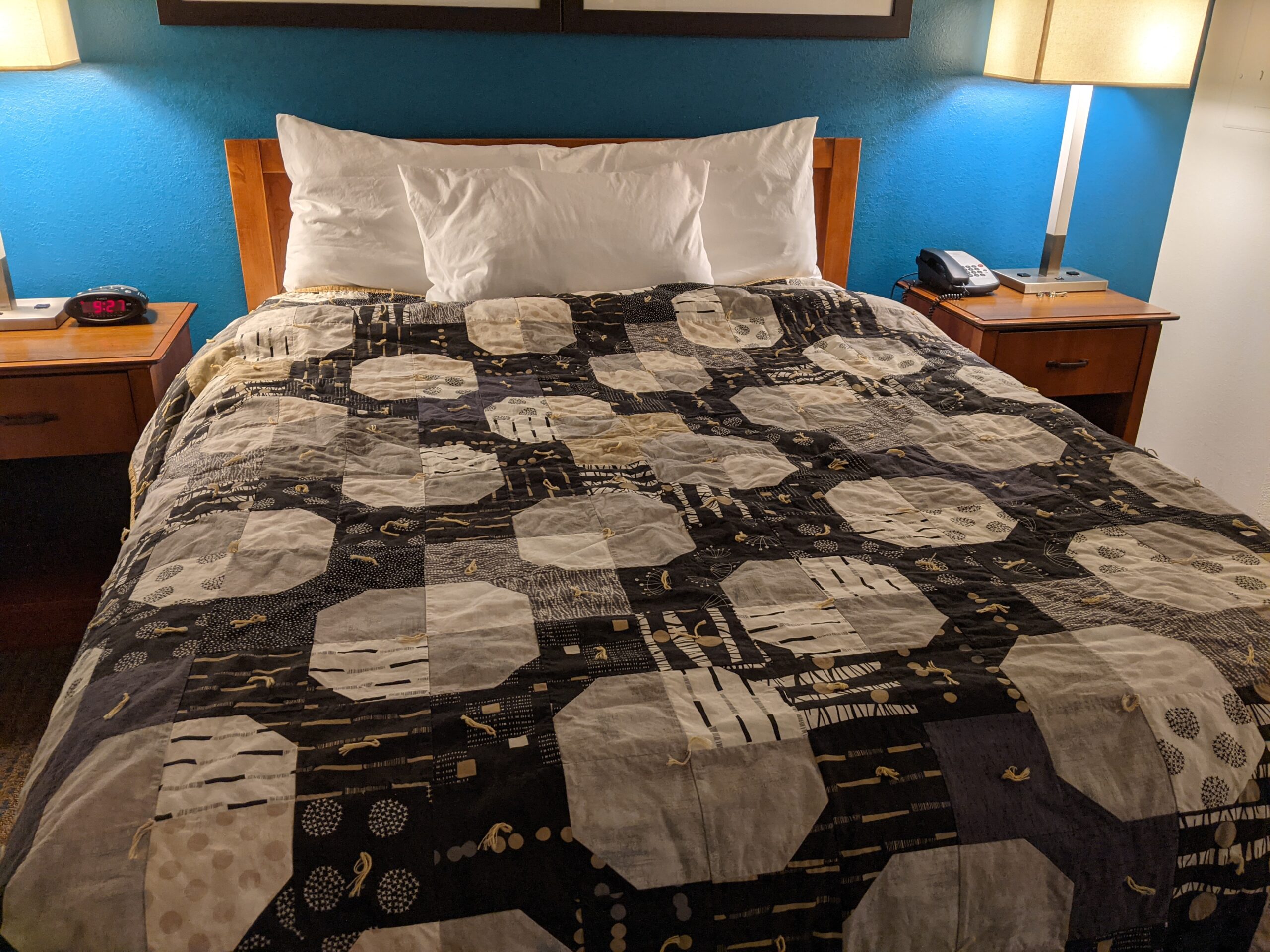
Admittedly, I stayed up until after 3am on the day we were driving out of state to the wedding, AND I spent that morning/early afternoon washing and drying both quilts in between hair appointments and packing. I also admit that the quilts did not get packed into their boxes until the hotel room either. However, hotel rooms are super convenient for photographing quilts! Who knew? The bed is made perfectly as long as you don’t throw a suitcase on it or anything like that, and generally the colors are neutral and there’s never any clutter…just saying.
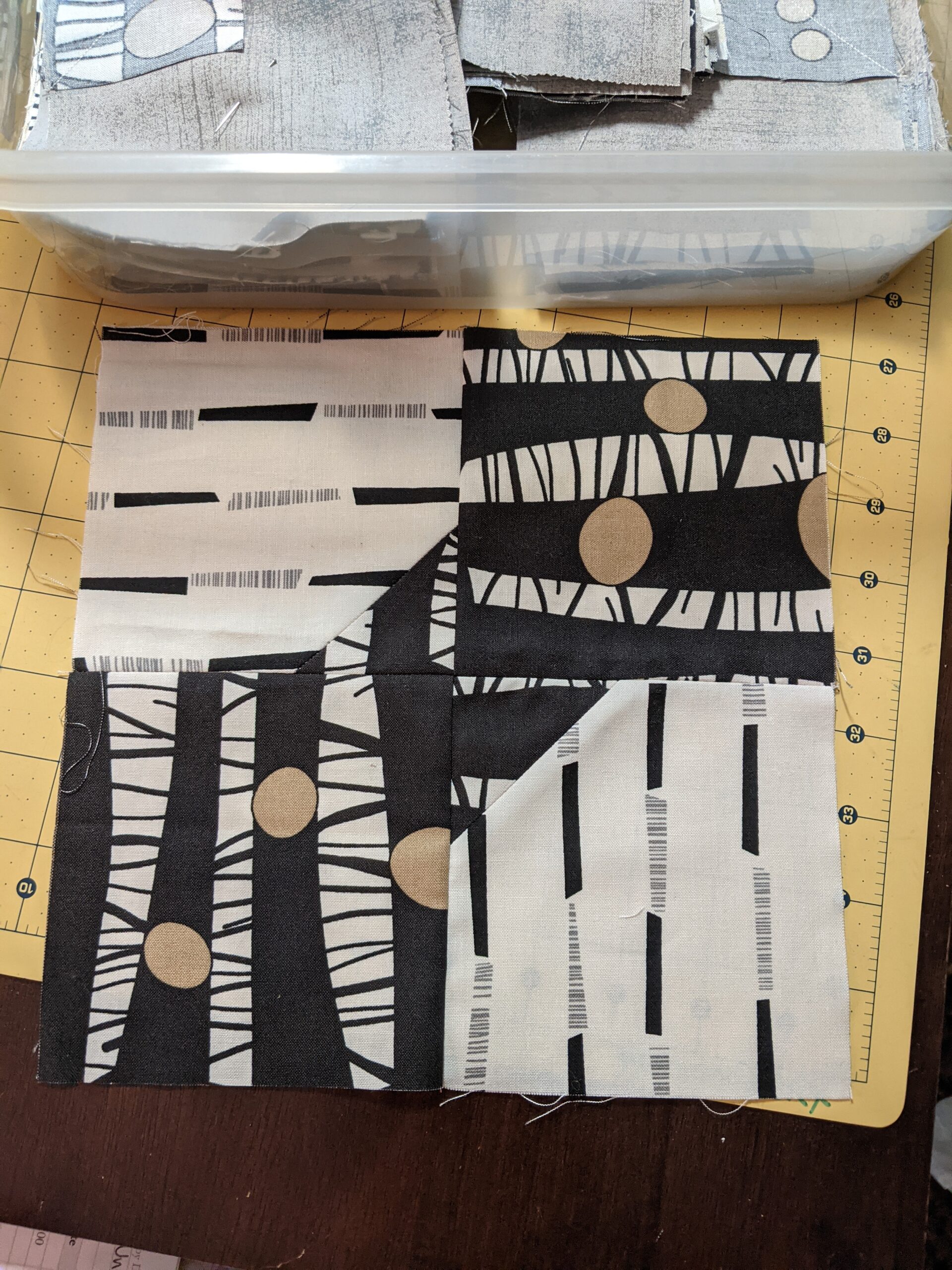
I was really thrilled with the end result of this quilt. In the middle of laying out the blocks before sewing the final rows together, I had a fear that it would look too busy or disjointed when it was put together. Luckily, as it was finally pieced and did what most quilts do: look amazing and blend perfectly.
This quilt is named “Unbreakable Ties.” It’s name is a play on so many things. My cousins “tied the knot” (and of course, to quote the amazing man who married them after a slight delay of game due to a downpour, “Wet knots can never be untied”) and the quilt was based on the vintage quilt block called the bowtie…and I even tied the quilt, instead of quilting it….a signature I’ve had for years as I feel it’s a nod to the practically ancient sewing technique. But even more front and center is the fact that as cousins, we have an unbreakable tie. I consider my “family” to be one of the most important things in my life. I say “family” because I have found that in my thirty-five years on this planet not all family is made up of blood relatives. I have both extremes in my life. I have blood relatives that are my rock and refuge and who I would walk through fire for. I have blood relatives who I do not acknowledge, nor do they acknowledge me. I find this a healthier relationship and I thank them for leaving me alone and “abandoning” me, as they did me the favor of removing their toxicity from my life. Sometimes people do you a favor by leaving you. It saves you the tumult, drama and heartbreak of having to cut them off later. But, I have also found that I have a family that is above and beyond my blood relatives. A small, amazing, and caring group of people that have been adopted into my family or have adopted me into theirs. These are the true family….the ones who stick it out even if they aren’t obligated to do so.
I hope this Quilt serves as a reminder that the tie between the recipients and myself is indeed Unbreakable. I consider myself lucky to have them in my life and don’t know a better way to express that then in my love of sewing.
Okay. Okay….enough of the sappy stuff. Here’s some technical notes I have. When using the AccuQuilt to cut fabric (I hate and love this thing at the same time…..more about that later, I think) I’m a heckler for not wasting fabric, and this causes trouble. To actually keep the grain lines properly aligned on the cutter, you will waste more fabric. (UGH!) So I didn’t do that…I paid for that by having a lot of stretching happen in my cutting. Luckily, with pins and time, I was able to have everything line up pretty well, but just know that moving forward if you are using that product.
I’ve been on a kick for the last few years to try and only use stash fabric for a quilt. Although not always possible (especially for backings), I’ve been pretty successful with this goal. This quilt definitely utilized some of the stash, but then added to my scrap pile….I’m working on a few “no waste” quilt patterns to solve this problem. We’ll all have to see what I can come up with.
Here’s the details on Unbreakable Ties
Title: Unbreakable Ties Pattern: Loosely based on the Pattern “Bow Tie Quilt” in the book Quilt Big by Jemima Flendt Size: Queen, finished ~81″ x 90″ Fabric: from the stash, the majority from the fabric line Kira by Stof Fabrics and Grunge Grey by Moda Piecing: Machine stitched on Mavis, the Bernina 770, with Connecting Threads Essential 50 weight, 100% Cotton, in White Cutting: AccuQuilt dies: 5″ square and 2.5″ square Quilting: Tied with Takhi Cotton Classic, 100% cotton yarn purchased at Cornwall Yarn Shop Backing: “Uncorked” by Another Point of View, 108″ fabric purchased from Connecting Threads Label: Hand Embroidered by Anne Lemin of Quilted Lovelies, hand stitched by Danika to attach to quilt Batting: Warm and Natural, by The Warm Company Finished Date: August 2021 Total Hours: ~90 hours
As you guessed by now, when you get engaged in my family, you get a Quilt. I am so blessed to have a family who loves and appreciates my craft. They love these quilts and treat them as the heirlooms that they were intended to …
Oh yes. The Magnum Opus. Several years ago (maybe ten?) my cousin Mary got engaged (yay!) but wasn’t going to get married until after she finished school. At the time, she was just starting her Master’s program and was planning on getting her Doctorate. For …